

Egypt’s President in Tanzania: Strategic Partnership
Dar es Salaam – Sudanhorizon– Special News
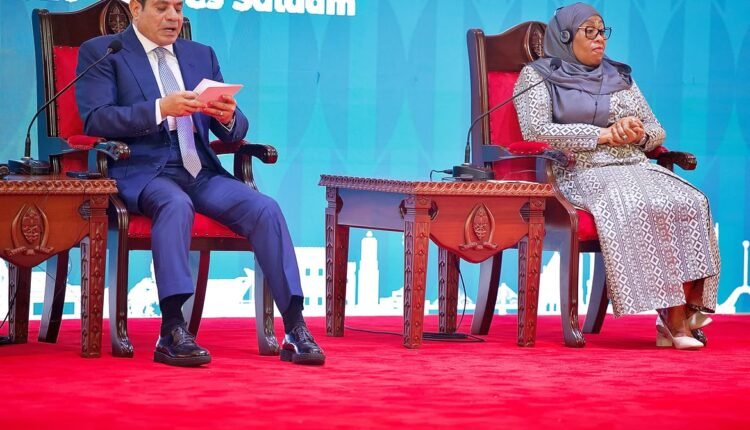
Tanzanian President Samia Suluhu Hassan held high-level talks with Egyptian President Abdel Fattah al-Sisi on Saturday at the Presidential Palace in Dar es Salaam, during a one-day state visit. The talks resulted in an agreement to expand bilateral cooperation in the energy, transportation, healthcare, science and technology, infrastructure, food security, and land reclamation sectors, as well as water resource management and regional security.
Memoranda of Understanding:
The two heads of state witnessed the signing of two Memoranda of Understanding in the fields of electricity and renewable energy, and transportation. Both parties affirmed their commitment to elevating bilateral relations to a strategic partnership based on increased investment, trade, and enhanced economic integration.
The discussions focused on developing transportation infrastructure, with both sides agreeing to strengthen cooperation in developing the Bagamoyo port and connecting it to the Standard Gauge Rail (SGR) line at Kuala in the Sahel region. This will support the movement of goods and regional logistics services. They also agreed to expand cooperation in the areas of ports, railways, maritime transport, and civil aviation, while consultations continue regarding strengthening maritime connectivity between the two countries.
Unprecedented Development:
The Egyptian President affirmed that bilateral relations have witnessed unprecedented development in recent years thanks to shared political will. He noted the two sides’ agreement to expand economic cooperation and increase trade and investment, while granting the private sector a greater role in implementing joint projects.
The talks also addressed regional issues, including developments in the Middle East, the Horn of Africa, and the Red Sea, in addition to regional security matters. Both sides emphasized the importance of political coordination and enhanced cooperation in combating terrorism, piracy, and transnational organized crime.
Water Issues:
Regarding the Nile waters, President El-Sisi stressed the importance of Tanzania’s role in supporting dialogue and cooperation among the Nile Basin countries. President Samia Hassan affirmed her country’s commitment to protecting the Lake Victoria ecosystem to ensure the sustainability of water flows into the Nile River, emphasizing that the river should remain a framework for cooperation and shared development.
Scholarships:
The two sides also agreed to expand cooperation in the fields of education, science, and technology. Egypt pledged to support Tanzanian capacity building in artificial intelligence, cybersecurity, and information and communication technology through scholarships and specialized training programs.
Joint Business Forum:
The two presidents attended the Tanzanian-Egyptian Business Forum in Dar es Salaam, with the participation of government officials, business leaders, and investors from both countries. Participants called for strengthening logistical connectivity, providing trade information, and expanding industrial partnerships as key tools for increasing trade and investment.
The Tanzanian Minister of Transport, Makame Mbarawa, announced that the two countries are nearing completion of arrangements for establishing the Dar es Salaam-Cairo Multimodal Logistics Center. This center will connect the port of Dar es Salaam with the Egyptian ports of Ain Sokhna and Safaga via the Indian Ocean, the Red Sea, and the Mediterranean Sea, providing a trade corridor linking sub-Saharan Africa with North Africa, the Middle East, and Europe. Executive Bodies
Egyptian Presence in Africa:
Observers of African political affairs believe that the visit’s outcomes reflect a clear Egyptian trend toward deepening its economic and strategic presence in East Africa through Tanzania, which serves as a gateway to the markets of the East African Community and the Great Lakes region.
The focus on ports, logistics, railways, and energy indicates a shift in cooperation from individual projects to building a long-term economic integration system. This could potentially place Egypt at odds with the interests of the UAE, which controls the port of Dar es Salaam.
Others believe that the understandings regarding water resource management and the Nile Basin carry political significance. They reflect Cairo’s efforts to enhance coordination with influential basin countries and broaden support for its approach based on dialogue and cooperation regarding the Nile waters. This also underscores Cairo’s commitment to strengthening its relations with upstream countries and preventing the Nile water issue from becoming a source of political tension. Furthermore, it represents part of a broader Egyptian strategy to protect its water security through a high-level presidential diplomatic plan in response to the Ethiopian-led framework agreement, which aims to curtail Egypt’s historical rights to the Nile waters.
The agreement to establish a multimodal logistics corridor between Dar es Salaam and Egyptian ports, and to link the port of Bagamoyo to the standard rail network, indicates a trend towards establishing a transport axis linking East Africa with its north, which contributes to increasing trade between Africa, the Middle East and Europe, and gives Tanzania a greater role as a regional logistics hub, and enhances Egypt’s position as a trade gateway to the continent.
Shortlink: https://sudanhorizon.com/?p=16086