

An American Newspaper: Sudan’s “looted Treasures”: More than 8,000 Artifacts
Sudanhorizon –Christian Science Monitor
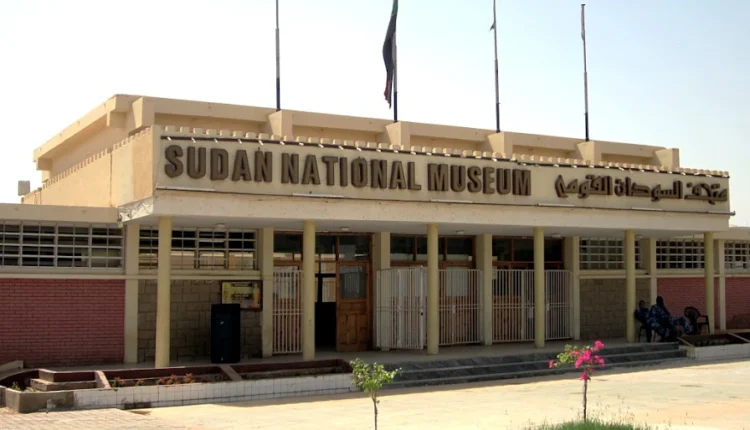
Nour El-Din Jadat wrote an article in the Christian Science Monitor, an American newspaper founded in 1908, about Sudanese artifacts looted by the Rapid Support Forces militia and the progress of efforts to recover them. He stated that since the outbreak of war, rebel forces had deployed snipers on the rooftops of the National Museum in central Khartoum and then stormed the museum. There, they found statues made of pure gold and precious stones, pottery, ancient murals, 4,000-year-old mummies, and Stone Age tools.
He adds, the museum was undergoing restoration, and many of the artifacts were carefully arranged in boxes inside a storage room, as if they had been prepared for looting.
The writer says that after three years of war, Sudan’s museums are in ruins, and the search for thousands of stolen artifacts is still in its early stages.
The article goes on to say that over the past three years, the conflict, which began near the National Museum, has spread to encompass most of Sudan. In the midst of this brutal conflict, the Rapid Support Forces and other looters have plundered at least 20 of Sudan’s museums, seizing more than 8,000 artifacts valued at approximately $150 million, according to the National Corporation for Antiquities and Museums in Sudan.
The publication notes that the race to recover the stolen artifacts has now begun, as the stakes far exceed the financial losses.
According to Mr. Abdel-Hay Abdel-Sawy, an official at the museum, artifacts are not merely museum pieces; they are tangible evidence of Sudan’s history and its successive civilizations.” When they are looted or destroyed, we not only lose the artifacts themselves, but also a part of our collective memory and cultural identity.”
Memory Theft:
UN investigators say the Rapid Support Forces militia is smuggling stolen artifacts across Sudan’s borders and selling them to international criminal gangs and antiquities dealers. Some have even been listed on eBay. The proceeds are then used to fund a war effort that Amnesty International recently described as “a stain on the conscience of humanity.”
The article notes that the stolen artifacts span thousands of years of Sudanese history.
Among the exhibits Abdul Hai Abdul-Sawi saw as he left the museum premises on Thursday, two days before the fighting broke out on April 15, 2023, was a collection of ushabti figurines. These small stone statues with crossed arms were placed in the tombs of the Kushite kings—often called the “Black Pharaohs”—who ruled vast areas of Sudan and Egypt in the 8th and 7th centuries BC. The ushabti figurines were believed to accompany the kings to the afterlife to perform manual labor and agricultural work on their behalf.
The only statue to survive the looting, a Kushite king from the 25th Dynasty dating back to the 7th century BC, stands in the National Museum in Khartoum, Sudan, on June 15, 2026. When the Sudanese army expelled the Rapid Support Forces from Khartoum in March 2025, Mr. Abdel-Sawy and his colleagues returned to the museum to find the Ushabti figurines, along with thousands of other priceless artifacts, missing.
The scenes that greeted them were appalling: display cases smashed and galleries empty. Spent ammunition casings littered the floor, along with cooking utensils and clothing left behind by the militia that had occupied the building. According to the museum administration, some 60% of its collection was lost.
Lost and Found:
But the museum administration was determined that this would not be the end of the story. After the outbreak of war, Sudanese archaeologists, in collaboration with officials from Interpol and the United Nations Educational, Scientific and Cultural Organization (UNESCO), quickly focused on the issue of the looting of national antiquities. Experts say that many of the artifacts looted by the Rapid Support Forces (RSF) and other thieves have made their way along known smuggling routes in Sudan’s western Darfur region, then on to neighboring Chad and South Sudan, where they quickly disappear into the black market.
Many of the artifacts are now believed to be circulating illegally, but “so far, none of the artifacts looted by the RSF have reached international auction houses,” says Ikhlas Abdel Latif, director of the museums department at the Sudanese National Corporation for Antiquities and Museums.
However, some have resurfaced. In January, the Sudanese government announced it had recovered 570 artifacts stolen from the country’s museums during the war, including dozens of ushabti figurines—funerary statues of Kushite kings—that Mr. Abdel Sawi had discovered.
The government has not disclosed where or how the missing artifacts were recovered, the newspaper notes, citing ongoing investigations into other thefts. However, the Spanish newspaper El País reported that they were found inside Sudan. With thousands of artifacts still missing – most likely outside Sudan – the recovered pieces represent only a small fraction of what was lost. However, Dr. Ikhlas emphasizes the symbolic importance of recovering even this number so far.
She says, “The recovery of these statues has restored hope to those concerned with protecting antiquities and heritage. It represents a first step in reclaiming a rich history that militias have worked hard to steal and destroy.”
Shortlink: https://sudanhorizon.com/?p=16392