

Al-Burhan: Sudan Committed to Climate Action
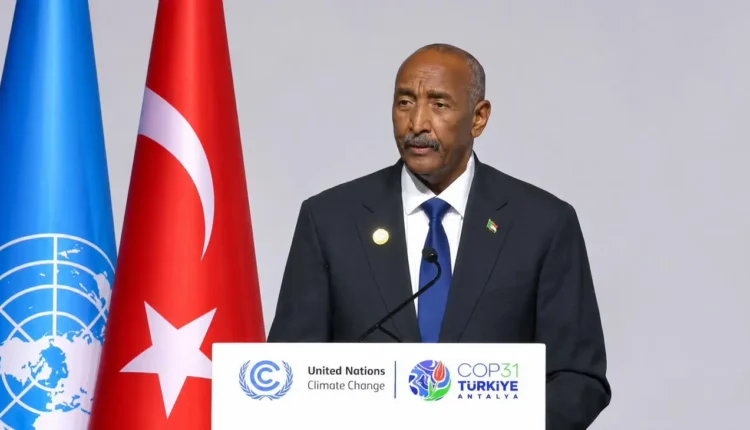
Antalya – Sudanhorizon
The Chairman of the Transitional Sovereign Council, General Abdel Fattah al-Burhan, has reaffirmed Sudan’s commitment to supporting the shared positions and principles of the African Group, the Arab Group, the G77 and China, and the Least Developed Countries (LDCs).
He emphasized the importance of strengthening international cooperation and solidarity to achieve a fair and effective response to climate change—one that takes into account the specific circumstances, capacities, and national priorities of developing nations.
Addressing the Conference of the Parties to the United Nations Framework Convention on Climate Change (COP31) in Antalya, Turkey, Wednesday, Al-Burhan stated that Sudan—despite the exceptional challenges it faces—continues to fulfill its climate commitments.
He noted that the country submitted its Third National Communication and its Biennial Update Report in April 2025, and is currently working on the preparation of its Fourth National Communication and its first Biennial Transparency Report.
He explained that Sudan is among the countries most severely affected by the negative impacts of climate change, despite its minimal contribution to global emissions.
He pointed to the escalating risks of drought, flooding, desertification, water scarcity, and land degradation—all of which lead to a decline in agricultural and pastoral production, thereby threatening food security and livelihoods.
Al-Burhan pointed out that the war the country has been experiencing since 2023—and the resulting damage to infrastructure, services, and national institutions—has compounded the scale of climate-related challenges. He emphasized that addressing the impacts of climate change in Sudan is intrinsically linked to achieving peace, food and water security, and sustainable development, as well as strengthening the resilience of communities.
He stressed that climate adaptation is an urgent national necessity for Sudan, calling for increased investment in water resource management, climate-resilient agriculture, the development of pastoral systems, the restoration of degraded land, the combatting of desertification, the protection of ecosystems, and the advancement of early warning and disaster risk management systems.
Regarding climate finance, Al-Burhan urged the transformation of international pledges into actual financial resources that are equitable, rapid, accessible, and predictable. He also called for strengthening national institutions to enable developing nations—particularly the least developed countries and those affected by conflict and crises—to effectively utilize financing mechanisms. Furthermore, he urged developed nations to double the funding allocated for climate adaptation programs.
Al-Burhan highlighted that Sudan possesses promising potential in areas such as renewable energy (notably solar power), land management, sustainable agriculture, ecosystem restoration, and water management. He invited international partners to support the conversion of this potential and these plans into practical, scalable investments and projects, which would help create job opportunities and bolster the nation’s capacity to confront climate change. He also emphasized the importance of leveraging climate action as a catalyst for fostering peace, development, food and water security, and stability, while building a safer and more equitable future for generations to come.
It is worth noting that the conference saw broad participation from heads of state and government—including UN Secretary-General António Guterres and Turkish President Recep Tayyip Erdoğan—who gathered to discuss international efforts to address the challenges of climate change and to strengthen cooperation among the participating nations
Shortlink: https://sudanhorizon.com/?p=20135