

Intense Diplomatic Influx into Sudan: How Could the Outcome Be Translated into Concrete Results?
Sudanhorizon- Exclusive
The past week, and the week that is about to end, have witnessed unusual diplomatic activities in the administrative capital, Port Sudan. Delegations from various regional and international bodies flocked into the coastal city to discuss with officials in the Government of National Accord what should be done to alleviate the suffering of the Sudanese people during the war.
Behind the Activity:
A high-ranking diplomatic source told Sudanhiorizon that this “rush towards Sudan” stems from two main reasons. The first is the emerging possibility of a ceasefire, following the momentum generated by the American-Saudi initiative and the related Quartet initiative. Consequently, many parties felt they needed to be present “on the ground” before a ceasefire became a reality, especially since the Western world is generally approaching the Christmas holidays, and most of its officials will be absent from the political scene for about two weeks.
The second reason, according to the high-ranking source, is that the scale of the humanitarian catastrophe and the crimes committed against the Sudanese people throughout the years of war, the horrific aspects of which were revealed to the world following the Rapid Support Forces’ takeover of El Fasher, has shaken the global conscience. It has confronted decision-makers in Western countries and international human rights organizations with stark realities that cannot be ignored, thus leaving no option but to act.
Humanitarian Dimensions:
The source, speaking to Sudanhorizon pointed out that the essence of the diplomatic activity witnessed in Sudan over the past ten days is humanitarian and developmental, rather than political. The nature of the delegations that arrived in Port Sudan falls within this framework.
Western Envoys:
In recent times, several Western special envoys have visited Port Sudan, meeting with a number of state officials and discussing various issues. Among the most prominent of these were the Norwegian and British envoys. However, this diplomatic activity – the source adds – escalated with a tripartite visit by envoys from what they termed the “Northern European countries” – namely Sweden, Finland, and Austria. During their visit to Port Sudan, they met with Prime Minister Dr. Kamil Idris, officials from the Sovereignty Council’s Humanitarian Affairs Office, and officials from the Ministry of Foreign Affairs.
Additionally, the Minister of Cabinet Affairs, Dr. Lamia Abdel Ghaffar, met with the UN Humanitarian Coordinator for Sudan, Denise Brown. The Coordinator briefed the government on the role of UN organizations in providing assistance to Sudan in the areas of education, health, and humanitarian aid, emphasizing its readiness to cooperate with the government to ensure effective coordination and the delivery of humanitarian aid to those in need. It expressed hope that peace would prevail throughout Sudan.
The Ministry of Finance at the Heart of the Activities:
A high-ranking diplomatic source, speaking to Sudanhorizon highlighted the importance of the activity undertaken by the Ministry of Finance and Economic Planning, represented by its Minister, Dr. Jibril Ibrahim, during the past period. The source considered this activity a prelude to normalizing Sudan’s financial relations with a number of regional and international institutions that have already engaged in the diplomatic efforts directed towards Sudan.
The source noted that during this period, the Minister of Finance held discussions with the Arab Monetary Funds, the African Development Bank, representatives from the World Bank, and a mission from the International Fund for Agricultural Development (IFAD). New understandings were reached, the benefits of which Sudan will reap in the upcoming fiscal year.
International Political and Humanitarian Mobilization:
The Special Envoy of the UN Secretary-General, Ramtane Lamamra, also visited Port Sudan at the outset of this diplomatic activity. He met with senior state officials, including the Chairman of the Sovereign Council, the Prime Minister, and the Minister of Foreign Affairs. He undoubtedly briefed them on the joint efforts undertaken by the United Nations, the African Union, the Intergovernmental Authority on Development (IGAD), the Arab League, and the European Union to establish a platform for dialogue among the Sudanese parties. This dialogue is now threatened by the insistence of this “quintet” on inviting the “Tassis” group, which has become the political front for the Rapid Support Forces militia.
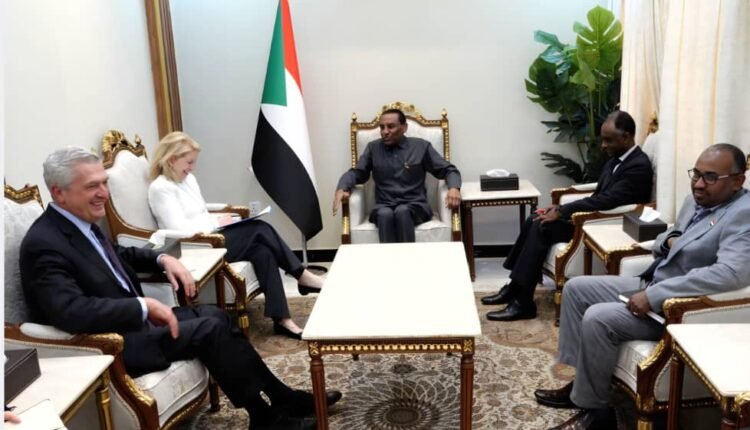
The most significant aspect of this international activity is the extended visit to Sudan by the UN High Commissioner for Refugees, Filippo Grandi, concluded yesterday. During his visit, and during which he had toured the Northern State and Khartoum State to assess the scale of humanitarian needs in displacement camps, listen to testimonies from survivors of the El Fasher tragedy, and review the steps taken by Khartoum State to relocate foreign refugees to border camps in Gedaref and White Nile states.
Although Grandi is not directly involved in the issue of displaced persons, the composition of his delegation and the meetings he held upon his return to Port Sudan with heads of UN offices—including the UN Humanitarian Coordinator in Sudan, the Executive Director of UNICEF, representatives of the World Health Organization, and others—clearly demonstrate the UN’s decision to engage constructively with the Sudanese government to address the humanitarian consequences of the Rapid Support Forces’ war on the Sudanese people and the country’s infrastructure.
What’s next?
This diplomatic activity, both bilateral and multilateral, undoubtedly did not arise in a vacuum. It is the result of intensive diplomatic efforts led by the Ministry of Foreign Affairs and several other state institutions involved in foreign affairs. However, this engagement requires close follow-up to ensure that the agreements reached are implemented and that Sudan can reap the benefits as soon as possible.
Shortlink: https://sudanhorizon.com/?p=9439