

Governor of Khartoum: Digital Transformation Key to Post-War Stage
Khartoum – Sudanhorizon
The Governor of Khartoum State, Ahmed Othman Hamza, has underscored the importance of leveraging modern technology to enhance government performance—specifically regarding official transactions, revenue collection systems, and correspondence between state institutions. He noted that the current phase demands a qualitative shift in government operational methods, one that aligns with reconstruction requirements and establishes an administrative and service-delivery landscape superior to what existed before the war.
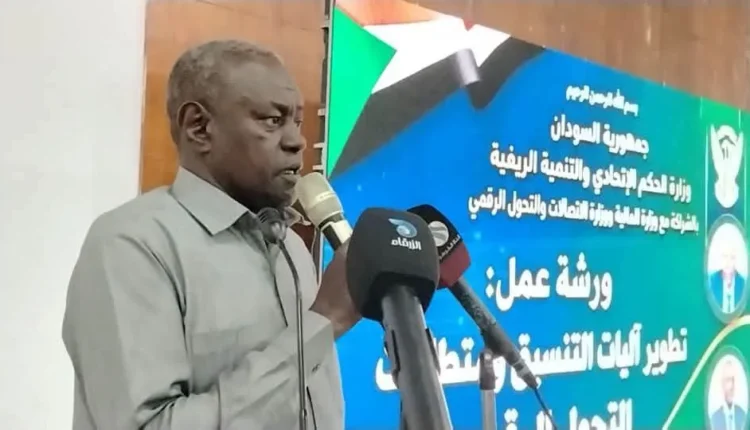
Speaking at the opening of a workshop on developing coordination mechanisms and digital transformation requirements—organized by the Ministry of Federal Governance and Rural Development at the Cultural Center in Omdurman this Sunday—Hamza emphasized the need to turn the challenges brought about by the war into opportunities for reordering priorities and refining institutional work systems.
He called for the creation of integrated, comprehensive databases covering all government transactions and activities—across state, local, and central levels—to boost operational efficiency and transparency, streamline procedures, accelerate the completion of tasks, and ensure the secure storage and retrieval of information.
The Governor of Khartoum affirmed his administration’s commitment to implementing the workshop’s outcomes and translating its recommendations into practical programs and plans. He highlighted the significance of the workshop’s timing, as it coincides with preparations for the 2027 fiscal budget.
For his part, Dr. Abazar Al-Hafiz Al-Tayeb, Undersecretary of the Ministry of Federal Governance and Rural Development, commended the efforts of state governments to build institutions better equipped to confront challenges and keep pace with global advancements in the management of public affairs. He stated that the current phase necessitates strengthening coordination and integration across various levels of governance, as well as aligning visions and efforts to achieve the goals of administrative reform and digital transformation.
He explained that the workshop is part of the Ministry’s initiative to unify efforts between the federal government and state-level governments, and to establish a practical foundation for building a digital state—one that leverages modern technology to manage its institutions and enhance its services.
He noted that the workshop aims to refine coordination among different levels of governance, streamline transactions for citizens, expand the delivery of government services, and ensure the efficient and effective utilization of available resources.
He added that building a digital state requires interconnecting institutions, facilitating information exchange, and consolidating databases. This, in turn, supports planning, monitoring, and oversight, while helping to address the shortcomings inherent in traditional operational systems.
For their part, several participating undersecretaries emphasized the importance of the workshop in fostering coordination between federal and state institutions and aligning perspectives on the requirements for digital transformation—particularly in the areas of finance, administration, revenue collection systems, and e-services.
They further noted that the success of digital transformation depends on the integration of efforts across ministries and relevant entities, alongside the provision of robust technical infrastructure and the continuous professional development of the workforce.
Shortlink: https://sudanhorizon.com/?p=20865