

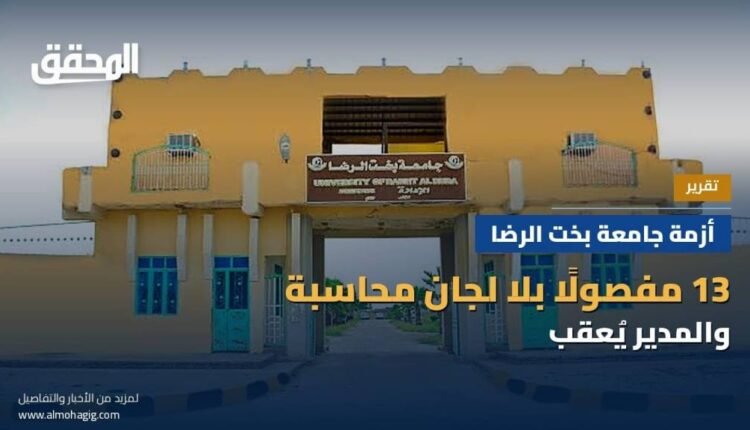
Sudanhorizon Exposes Crisis at Bakht Al-Rida University: 13 Staff Dismissed Without Disciplinary Hearings… University Director Responds
Sudanhorizon – Nashwa Ahmed Al-Tayeb
In the city of Al-Duweim, White Nile State, stands Bakht Al-Rida University, successor to one of Sudan’s oldest teacher-training institutes.
From within this university, Sudanhorizon examines the cases of lecturers and employees who found themselves outside its gates after receiving dismissal letters no longer than a few lines.
Sudanhorizon has obtained more than 14 documents, including official dismissal letters, correspondence exchanged between the university and the Ministry of Higher Education, and a collective complaint submitted by 13 lecturers and employees to the Minister of Higher Education and Scientific Research, Ahmed Mudawi Musa. The dispute remains unresolved, with an ongoing exchange of correspondence between the university and the ministry.
Sudanhorizon contacted the university’s director, Mutaz Billah Bakri, but he did not answer any of the questions put to him. He merely stated that a dismissal by operation of the regulations “does not require an investigation or disciplinary proceedings”, before accusing the investigation of seeking to “brand the university as unjust”.
Thirteen Signatures on a Single Document
On 4 March 2026, a six-page complaint bearing the signatures of 13 Bakht Al-Rida University staff members reached the minister’s office. They include a professor, an associate professor, an assistant professor, lecturers, teaching assistants and administrative employees. The longest-serving among them joined the university in 1997, while the most recent joined in 2016.
What they have in common is that all were dismissed. Some were dismissed on grounds of “absence”, while others were dismissed for “exceeding the training period”. They say the dismissal decisions were issued without an investigation, without a disciplinary board hearing, and without anyone giving them an opportunity to present their case.
The signatories accuse the university administration of failing to take into account the circumstances that have shaken the country since 2018, when the revolutionary movement began, through to April 2023, when the war broke out. They conclude their complaint by appealing to the minister to intervene, review the director’s decisions and redress the injustices they say they have suffered.
Similar Letters, One Signature
Sudanhorizon reviewed 12 dismissal letters that are almost identical in structure. Each is a single page beginning with the phrase “With reference to letter…”, followed by a reference to a directive from the university director or deputy director, and ending with a decision to dismiss the employee “by operation of the regulations” from a specified date. All bear the signature of the Director of Administrative Affairs, Salha Mohamed Shoaib.
Notably, the letters do not rely on a single legal basis. In the cases of Professor Waleed Abdel Rahman and Dr Wijdan Samir, the administration cited Article 117 of the 2022 Regulations Governing the Service of Teaching Staff. In Dr Mohamed Saleh Othman’s case, it invoked Article 110 of the Regulations Governing the Work of Teaching Staff. Meanwhile, the cases of Naeem Abdel Rahim, Fatima Omar Abdin, Ashraf Abdel Wahab and Dr Al-Siddiq Abdel Qadir were dealt with under Article 150 of the 2007 National Civil Service Regulations.
In a separate category, dismissal decisions for “exceeding the training period” followed an audit observation issued by the Office of the Auditor-General in White Nile State on 11 December 2022. These decisions were based on Article 18 of the 2022 Regulations Governing the Training of Teaching Staff and affected five lecturers and teaching assistants during 2023.
As the War Approached Al-Duweim
Most of the dismissal decisions on grounds of absence were issued in 2024 and 2025, as the war was drawing closer to Al-Duweim. In December 2024, residents and volunteers fighting alongside the army reported that Rapid Support Forces (RSF) troops had advanced into villages north of Al-Duweim in White Nile State, triggering a wave of displacement.
The complaint states that several of those dismissed were stranded outside the state because of the war. Among them was Dr Wijdan Samir Abdullah of the Forestry Department at the Faculty of Agriculture, who was dismissed despite, according to the complaint, continuing to teach her courses online.
Another was Fatima Omar Abdin, a programming technician at the Deanship of Graduate Studies. She was dismissed by a letter issued on 22 May 2024, following a directive from the university’s deputy director, on the grounds that she had been absent since 1 March.
Also among them was Ashraf Abdel Wahab Ibrahim, an auditor in the Internal Audit Department, who was dismissed on the grounds of absence since June of the same year.
“Dismissal by Operation of the Regulations”… But Where Is the Investigation?
The entire dispute revolves around one legal question: Does the university have the right to dismiss an employee through an administrative letter simply because they have exceeded 45 days of absence?
The dismissed employees rely on the 1994 Regulations Governing the Disciplinary Accountability of Employees in Higher Education and Scientific Research Institutions, issued by the National Council for Higher Education under the Higher Education Regulation Act of 1990. Sudanhorizon has obtained the full text of these regulations.
Article 5 of the regulations classifies “absence from work without permission or an acceptable excuse” as a disciplinary violation for which an employee may be held accountable. Article 6 stipulates that no employee may be referred for disciplinary proceedings “except on the basis of an investigation authorised by the competent authority”. Article 19 further provides that dismissal from service for absence is a penalty that may only be imposed by a disciplinary board.
The university’s own founding law also settles the question of which legal framework applies. It stipulates that the Higher Education and Scientific Research Regulation Act of 1990 applies to Bakht Al-Rida University, and that its provisions take precedence in the event of any conflict with the university’s own law.
The Ministry Issues Directives… The University Does Not Comply
Professor Waleed Abdel Rahman Mustafa has been a member of the teaching staff at the Faculty of Agriculture and Natural Resources since 2003. He was dismissed under letter No. ج ب ر/ش أ/50/أ/1, dated 5 August 2024, on the grounds that he had been absent following a period of leave extending from March to June. The dismissal letter refers to a letter from the faculty dean issued on the same day.
The complaint states that Waleed continued teaching his courses online throughout that period, and that the university itself approved the examination results for the period during which it had classified him as absent.
Nearly two years later, a response came from the highest authority in the sector. On 12 July 2026, the minister’s Executive Office wrote to the university director under letter No. و ت ع ب ع/م و ت, signed by Dr Murtada Ali Osman.
The letter stated that the ministry’s Legal Department had confirmed that the procedures were invalid because they violated Article 5 of the 1994 regulations, and that the minister had approved the cancellation of the dismissal decision and instructed the university to follow the regulations.
Waleed waited seven weeks before writing to the director on 2 September 2026. He demanded implementation of the minister’s decision within 72 hours and payment of his outstanding entitlements from June 2024 to August 2026.
The response came in two lines, stating that the university administration had informed the minister of the “soundness of the administrative and regulatory procedures”.
However, that response was dated 1 September, a full day before the letter to which it purported to respond.
As of the publication of this report, the minister’s decision had not been implemented.
One Reinstated… Four Still Outside the University
On 1 November 2023, Rashida Abdullah Babiker, a lecturer at the Faculty of Agriculture, was dismissed for violating Article 18 of the Training Regulations, based on an audit observation issued by the Office of the Auditor-General.
The same audit observation and article formed the basis for the dismissal of four others: Salafa Ahmed Omar Bakhit of the Faculty of Education; Marwa Mohamed Ahmed Al-Nil of the Faculty of Agriculture; Habibullah Abdullah Ahmed Karoum of the Faculty of Science; and Abdel Rahman Mohamed Ali Suleiman.
However, Sudanhorizon has confirmed that the university administration reinstated Rashida, while her four colleagues remain dismissed. The administration has not disclosed the decision under which she was reinstated or explained why the same standard was not applied to the others.
The Director Responds
The Sudanhorizon reporter sent seven written questions to the university director, Professor Mutaz Billah Bakri, concerning the issues raised, requesting a response as soon as possible.
The director’s reply came from outside Sudan and did not address any of the questions individually. Instead, he asked that a Sudanhorizon representative visit the university’s premises when he returned, in order to review the decisions and regulations on which the administration had relied.
Regarding the dismissal decisions, the director said Article 117 was titled “Dismissal by Operation of the Regulations” and that such dismissal “does not require an investigation or disciplinary proceedings”. He added that any employee who is absent for more than 45 consecutive days is automatically dismissed, describing this as an established regulatory procedure.
He said the dismissed employees had appealed to the Legal Department at the Ministry of Higher Education on several occasions, but that their appeals had been definitively rejected.
However, this statement appears inconsistent with the ministry’s letter dated 12 July 2026, which stated that the same Legal Department had confirmed the procedures were invalid and that the minister had approved the cancellation of the dismissal decision.
The director also insisted that the university had never stopped operating during the war, saying: “The university was working. It did not stop for a single day, and everyone was present.”
He hinted that some of those dismissed had “committed other things”, adding: “I don’t want to tell you about them.” He promised to present those reasons along with supporting evidence.
Shortlink: https://sudanhorizon.com/?p=20566