

Sudanhorizon Reveals: Gezira Project Launches Pump Rehabilitation with Solar Power for the First Time
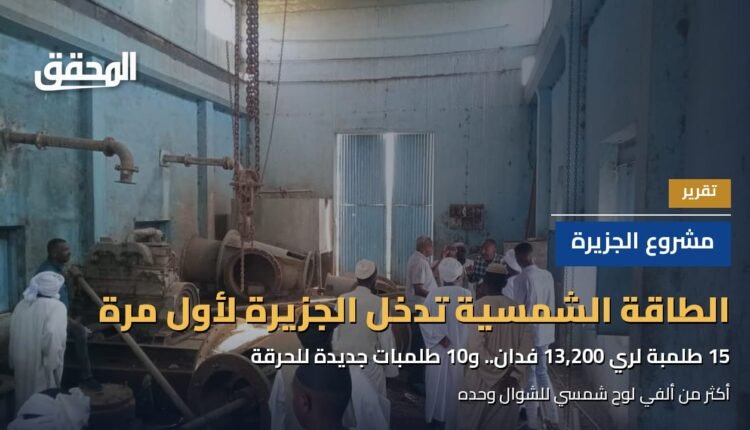
15 pumps to irrigate 13,200 feddans across three sites using solar and electric power
Sudanhorizon – Nashwa Ahmed Al-Tayeb
Sudanhorizon has learned of a plan to introduce solar energy for the first time in the Gezira Scheme to operate irrigation pumps, following years of hardship throughout the war.
During those years, pumps went out of service after being damaged, water stations became difficult to operate, and regular irrigation was held hostage to fuel and electricity shortages. The current agricultural season has also been affected by a shortage of diesel and delays in clearing irrigation canals.
According to a source at the scheme who spoke to Sudanhorizon, the plan targets the rehabilitation of three irrigation sites comprising 15 pumps, with the aim of addressing operational problems at water stations and meeting the irrigation requirements of the agricultural season across 13,200 feddans. Some of the sites will operate using solar power, while others will rely on electricity. At the Al-Harqa Agricultural Project, technical teams are currently on site installing ten new pumps to replace units destroyed during the war.
These steps follow directives issued by Chairman of the Transitional Sovereignty Council, General Abdel Fattah Al-Burhan, to provide solar power systems, at the state’s expense, for mechanically irrigated agricultural projects across Sudan. The aim is to overcome fuel and electricity-related problems and ensure the continuity of irrigation and agricultural production.
Presidential Directives to Support the Agricultural Sector
On 14 October 2026, Al-Burhan met at the Republican Palace with a delegation of farmers and producers from the Gezira and Managil Scheme, in the presence of the project’s Board Chairman, Lieutenant General Dr Khalid Abdeen Al-Shami. The meeting discussed the challenges facing the scheme.
During the meeting, the Chairman of the Sovereignty Council announced a donation of 22 agricultural vehicles to farmers’ and producers’ associations to help clear irrigation canals, 20 vehicles for the Council for the Regulation of Agricultural Production Professions, and SDG 50 billion to support fuel supplies and irrigation pumps.
On 31 October 2026, a further directive was issued to provide solar power systems, at the state’s expense, to all mechanically irrigated agricultural projects across the country.
The directive was announced by Sovereignty Council Chairman’s Adviser Amjad Farid, who said the aim was to overcome the effects of the fuel and electricity crisis and end reliance on both sources to operate irrigation systems, thereby supporting the continuity of agricultural production.
In this context, the plan to rehabilitate irrigation sites in the Gezira Scheme is one of the proposed measures to meet the needs of areas that depend on pumps for irrigation water, with the proposed energy source varying from one site to another.
15 Pumps Targeting 13,200 Feddans
The source told Sudanhorizon that the current plan covers three sites: Waqi Allah, Al-Waha and Al-Bariab, comprising 15 pumps intended to irrigate 13,200 feddans.
He explained that the Waqi Allah site is located at kilometre 131 on the Al-Shawal Minor Canal and has eight pumps serving 6,000 feddans. The Al-Waha site is located at kilometre 153 on the same canal and has four pumps serving 3,000 feddans.
At the Al-Bariab site, the plan targets the rehabilitation of three pumps to irrigate 4,200 feddans.
According to the source, the Waqi Allah and Al-Waha pumps will operate using solar power, while the Al-Bariab pumps will run on electricity. Technical specifications are currently being prepared to determine the energy and water requirements of each site for irrigating the targeted areas.
Al-Shawal: More Than 2,000 Solar Panels
As part of preparations for implementation, a team of engineers visited the Al-Shawal area, spending an entire day inspecting the sites, assessing their current condition and identifying their technical and engineering requirements.
The visit covered the Waqi Allah and Al-Waha sites, both of which depend on pumps to obtain irrigation water. Work is under way to determine the requirements for installing solar power systems at the two sites and preparing them to receive the equipment.
The source revealed that the Al-Shawal site alone requires more than 2,000 solar panels, a figure that could increase depending on the findings of the studies and final technical specifications. This will require a large area for installing and preparing the panels, as well as arrangements to protect and secure them.
The work is not limited to power systems. Preparing the sites also requires addressing civil and engineering works related to irrigation to ensure that the infrastructure is ready to accommodate and operate the pumps.
Tender Documents and Specifications to Be Finalised Before Implementation
The source explained that the engineering team had assessed the actual requirements of the sites, and that work was now under way to prepare the tender documents and submit the technical specifications ahead of inviting companies to bid for the work.
Under the announced arrangements, the tender is expected to be issued within ten days, with a 15-day bidding period. The bids will then be opened and the contract awarded to the implementing company, after which work will begin.
The source added that the tender documents would include technical guarantees and an extended warranty period, with the details to be specified in the final requirements to ensure the quality of the work and the efficiency of the systems after installation.
Civil Works to Be Completed Before Pumps Begin Operating
In addition to installing pumps and power systems, the work in the Al-Shawal area includes maintenance of several irrigation network structures, including canals, bridges, gates and regulators.
The engineering team’s inspections identified these works as necessary before the sites can become operational. Providing a power source alone does not guarantee that water will reach the targeted areas unless the relevant structures and canals are also properly prepared.
According to the source, the work is expected to be completed before the end of the winter season on 31 March, with the targeted sites scheduled to become operational during the next summer season.
Al-Harqa: Installation Teams Already on Site
The Al-Harqa Agricultural Project also relies on pumps for irrigation. Its previous pumps were damaged by the Rapid Support Forces militia, leaving them completely out of service and ending their use in supplying water to the project.
According to the available information, the pumps have been replaced with ten electric-powered units financed by the Ministry of Finance. The new units have arrived at the site, and the project is now at the installation stage, with technical teams working in the field to secure the units and prepare them for operation.
The new pumps are expected to enter service during the next summer season, irrigating an area of 5,760 feddans.
The Al-Harqa Project is a separate track from the plan covering the three sites of Waqi Allah, Al-Waha and Al-Bariab, in terms of the number of pumps, targeted area and funding source. It is also further ahead in implementation: the three sites are still at the tender-preparation stage, while work at Al-Harqa has already moved to on-site installation.
Diesel: A Challenge That Affected the Agricultural Season
Regarding the main challenges farmers faced this season, the source said that securing diesel was one of the biggest obstacles, as fuel shortages disrupted agricultural operations and delayed excavation and irrigation canal-clearing work.
He added that the problem was not limited to the Gezira Scheme but was linked to the wider circumstances facing the country. He confirmed, however, that the situation had now stabilised and diesel was available.
This account shows that regular irrigation depends on fuel availability, alongside maintenance and rehabilitation requirements. Current plans seek to address these challenges by improving infrastructure and diversifying the energy sources used to operate pumps.
Solar Energy and the Test of the Next Agricultural Season
The introduction of solar energy is particularly significant for the Gezira Scheme, as it is the first initiative of its kind there, according to the source. He expressed hope that it would help resolve energy problems in the targeted areas and provide a more stable power source for operating the pumps.
With the plan to rehabilitate 15 pumps at Waqi Allah, Al-Waha and Al-Bariab, alongside the installation of ten new pumps at Al-Harqa, efforts are moving towards restoring the capacity of several agricultural sites to deliver irrigation water to their targeted areas.
However, the process is not yet complete. At the three sites, tendering, contract-awarding and implementation procedures are still under way, while installation work continues at Al-Harqa to complete the fitting and commissioning of the pumps.
The next summer season will therefore provide the practical test of whether these works can restore regular irrigation and ensure that the targeted agricultural areas receive the water they need.
Shortlink: https://sudanhorizon.com/?p=20519