

British Writer Asks: How Can a Representative of a Country Accused by the UN of Fueling One of the World’s Worst Conflicts Become the “Voice of the Oppressed”?
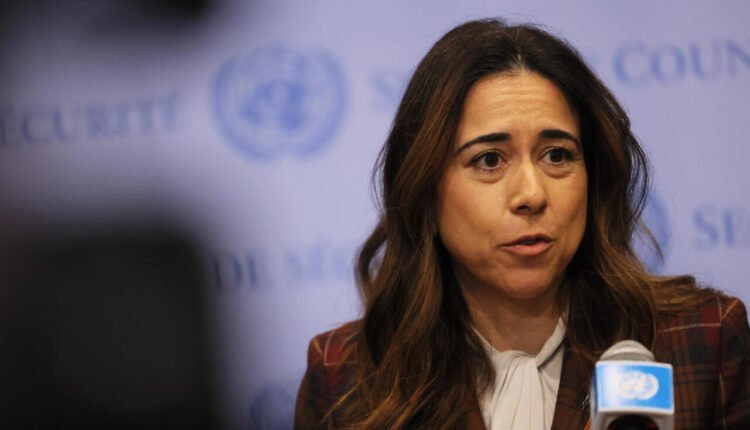
British Writer Asks: How Can a Representative of a Country Accused by the UN of Fueling One
Sudanhoriaon – Mohamed Osman Adam
A British writer argued in The Guardian newspaper yesterday (Monday) that the United Kingdom should use its veto to prevent the United Arab Emirates’ candidate from taking up a senior position at the United Nations in the coming weeks, should she get past the veto hurdle posed by the five permanent members of the UN Security Council.
However, the writer’s argument rests entirely on moral and ethical grounds, overlooking the economic and financial pressure that the UAE might bring to bear on Britain if the latter decided to block its candidate’s nomination.
The writer, Steve Bloomfield, formerly a senior writer at The Observer, argues that Britain could use its veto to prevent the UAE’s candidate from becoming UN Secretary-General, and that British Foreign Secretary David Lammy should do so.
Bloomfield argues that Lana Nusseibeh, the Emirati candidate for UN Secretary-General, appears to have the backing of Russia and the United States. However, her role in covering up atrocities committed in Sudan makes her unfit for the position, and this must be stated openly.
He points out that, since the devastating war broke out in Sudan in 2023, the UN Panel of Experts has undertaken some of the most effective investigative work in identifying those responsible. Its reports have revealed clear evidence indicating that the United Arab Emirates supplied weapons and mercenaries to the Rapid Support Forces (RSF), a Sudanese militia accused of committing genocide.
The writer adds that these reports, prepared by investigators funded by the United Nations, are the very reports cited by UN Secretary-General António Guterres whenever Sudan is discussed.
Whenever a report has been published—or leaked—Nusseibeh has been at the forefront of efforts to refute its findings, a pattern that has continued for a considerable period. For more than a decade, she has held senior diplomatic positions in the UAE, spending nearly 11 years representing her country at the United Nations before recently taking up a ministerial position at the Emirati Ministry of Foreign Affairs. Throughout this period, Nusseibeh has repeatedly denied the UAE’s involvement in fuelling the conflict and has publicly challenged the UN Panel of Experts’ conclusions.
Bloomfield writes:
“Yet there is a strong possibility that Nusseibeh will replace Guterres in the coming weeks and become the next Secretary-General of the United Nations. This would mean that a representative of an authoritarian regime—with a dreadful human rights record, and accused by the United Nations itself of fuelling one of the world’s worst conflicts—could become the ‘voice of the oppressed’!”
The writer explains that, until only a few weeks ago, Lana Nusseibeh was not among the declared candidates. The race to succeed Guterres had remained deadlocked for months, with earlier candidates struggling to secure the support of the major powers.
In the writer’s view, however, this appears to have been part of a plan. Nusseibeh’s late entry enabled her to avoid months of election rounds and interviews around the world that would have subjected her to much closer scrutiny. It also ensured that her rivals had little time to mobilise any substantial opposition to her candidacy.
Furthermore, the writer adds, the final decision is taken behind closed doors and rests with the five permanent members of the Security Council, collectively known as the P5. A candidate’s name is not submitted to the 193-member UN General Assembly until the five permanent members have reached agreement. The General Assembly then votes to endorse the selection.
In the latest informal straw poll within the Security Council, Rebeca Grynspan, former Vice-President of Costa Rica and Secretary-General of the United Nations Conference on Trade and Development (UNCTAD), received the most votes. However, at least two of the five permanent members appear to oppose her candidacy.
Although the major powers are reluctant to disclose publicly which candidates they support, several UN observers and diplomats believe Nusseibeh’s candidacy enjoys the backing of both the United States and Russia. This raises concerns that the election may have been arranged in advance by parties that are, in reality, among the most opposed to the very idea of the United Nations.
This election is taking place against a bleak international backdrop. Multilateralism is under attack, authoritarian tendencies are growing, and the world is becoming more dangerous and unstable by the day. One of the few constants in “Trumpism” is the drive to undermine the United Nations, from the United States’ withdrawal from numerous UN bodies to the creation of parallel structures such as the “Board of Peace”. As I have argued before, the US President favours a world divided into spheres of influence, where military and economic power reign supreme, while democracy and human rights carry little weight.
The writer explains that this approach, based on “mutual interests”, also serves the United Arab Emirates. For years, Abu Dhabi has used its oil wealth to build relationships around the world, whether through purchasing defence systems, establishing ports or investing in cultural institutions in other countries. It is worth noting that the UAE maintains close and important relations with all five permanent members of the Security Council.
Last month, France revived plans to develop a new Rafale fighter aircraft in cooperation with the UAE, following a meeting in Abu Dhabi between French President Emmanuel Macron and UAE President Sheikh Mohammed bin Zayed Al Nahyan. Meanwhile, a trade agreement between the UAE and Russia entered into force, with both sides hoping to increase annual bilateral trade to $50 billion by 2032. The UAE was also among the first overseas destinations Donald Trump visited during his second term, when he announced new deals between the two countries worth $200 billion. China, meanwhile, remains the UAE’s largest trading partner.
Then there is the United Kingdom. Its relations with the UAE have recently been described as “lukewarm”, although the coolness appears to come from Abu Dhabi alone. British officials, by contrast, seem eager to do everything possible to win the UAE’s favour. Unlike the UN Panel of Experts, no British foreign secretary has been willing to identify the UAE as one of the parties fuelling the conflict in Sudan.
All this has raised concerns among civil society organisations and non-governmental organisations that the United Kingdom may not stand in the UAE’s way, thereby paving the way for Nusseibeh to become Secretary-General.
The writer says that, when Ed Miliband took office as Foreign Secretary in July, he made it clear that he would work to “defend our values of democracy, freedom and the rule of law on the international stage”. His announcement of economic sanctions against Israeli settlers, and his description of Israel’s occupation of the West Bank as “illegal”, have demonstrated that these statements were not merely empty words.
But the struggle for “democracy, freedom and the rule of law” is ongoing. If Miliband is serious about restoring respect for international law and placing human rights at the heart of foreign policy, he cannot follow Trump and Vladimir Putin’s example by lending British support to the Emirati candidate. This may affect relations with the UAE, but that is no justification. It may also prove impossible to reach agreement on another candidate, leaving the United Nations without a leader from January onwards. That, too, is no justification.
Under no circumstances should the United Nations be run by the mouthpiece of an authoritarian regime. Britain has the power of veto, and it must use it.
Perhaps the Americans have found other countries willing to “eat garlic on their behalf”, as the people of the Levant say!
It is true, as the writer points out, that the new Foreign Secretary, Miliband, has matched words with deeds in expressing his desire to steer the world towards respect for human rights and the highest international principles. His criticism of Israel’s occupation policies—which he described as illegal—is sufficient to suggest that he might take a similar stance on the UAE’s candidacy.
However, politics in our contemporary world often succumbs to economic pressure. Many countries, including the United Kingdom, have been forced to swallow the bitter pill of compromise under such pressure. The writer himself alludes to this reality when discussing the economic and financial irregularities associated with Manchester City, the football club owned by a member of the ruling Al Nahyan family. The British government has continued to drag its feet over taking any action against the club or its owner.
Nevertheless, I would suggest, in disagreement with the writer, that the British government might reach a deal with the UAE in which ending the war in Sudan would serve as an incentive.
Let us look at the latest developments on the ground. The Sudanese army is advancing on several fronts in Kordofan and Darfur, giving it the upper hand and suggesting the war may be approaching its end. If Emirati support for the RSF militia were to stop, its defeat would become imminent.
It is, however, generally accepted that in wars there is no such thing as “absolute defeat”. Every war must eventually end in a peace agreement, and in any such agreement, a victorious party imposes its terms. Each side may claim victory, but, to borrow the words of the English writer George Orwell, author of Animal Farm, there will be “one side more victorious than the other”.
For that reason, any such agreement, whether we like it or not, will inevitably take indirect account of the power driving events from behind the scenes.
Shortlink: https://sudanhorizon.com/?p=20308