

Khartoum Considers Action Over UK and Japanese Meetings with RSF
Sudanhorizon – Agencies
High-level government sources revealed to *Sudan Tribune on Saturday that authorities intend to take measures regarding recent meetings held in Nairobi between British and Japanese officials and leaders of the Rapid Support Forces (RSF) militia to discuss humanitarian affairs.
On January 28, the Sudanese government had warned foreign agencies and organizations against dealing with the “Sudanese Agency for Relief and Humanitarian Operations,” an entity affiliated with the RSF.
At the time, Khartoum deemed that move a violation of national sovereignty and an acknowledgment of institutions parallel to the legitimate authority, threatening legal and administrative actions—including the revocation of work permits.
The sources condemned the Nairobi meetings, asserting that they were held with “Kenyan complicity” and violated UN Security Council resolutions rejecting the establishment of a “parallel government”—a move seen as threatening Sudan’s unity and peace efforts.
They noted that these actions conflict with the statement issued by the African Union Peace and Security Council on July 29, 2025, which condemned the formation of a parallel authority and urged the international community to limit engagement to the Sudanese government led by the President of the Sovereign Council, General Abdel Fattah al-Burhan, and the transitional cabinet, pending agreement on a broader government.
The government is currently assessing these developments to determine an appropriate official response, according to the same sources. According to information obtained by *Sudan Tribune*, British officials emphasized that their engagement with Rapid Support Forces (RSF) leaders is necessitated by the need to ensure the flow of aid and the protection of aid workers in areas under RSF control—particularly regarding humanitarian truces—stressing that such contact does not in any way imply recognition of the so-called “Founding” government.
The British side sought Khartoum’s approval for organizations to register with the RSF’s humanitarian arm to facilitate field operations—a request that was met with a categorical refusal by the government.
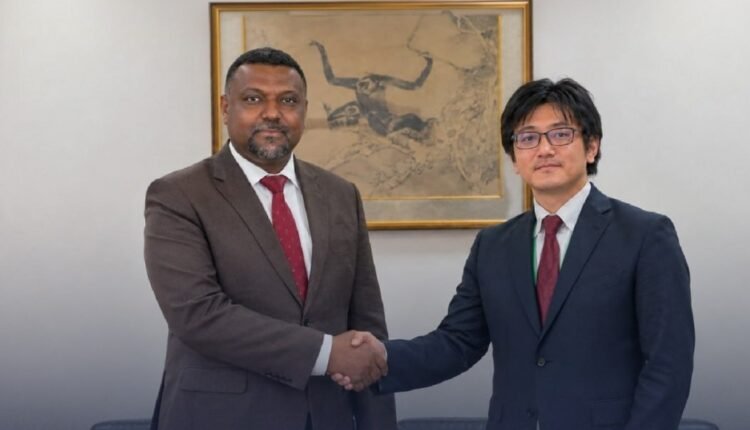
Izz al-Din al-Safi, head of the RSF’s National Humanitarian Access Authority, had met in Nairobi on Friday with Richard Crowder, the UK’s Head of Mission and Special Representative for Sudan, along with his humanitarian and development team.
The meeting addressed ways to expand humanitarian access to affected communities, protect civilians, and enhance cooperation with international organizations in areas controlled by what they termed the “Peace Government.”
In a related development, Al-Safi held similar talks in Nairobi last Tuesday with the Japanese Chargé d’Affaires, Takahara Takunobu, to discuss joint coordination.
Al-Safi expressed the “Peace Government’s” appreciation for the aid provided by JICA, reiterating the pledge to provide the necessary facilities to ensure the flow of supplies.
Conversely, government sources questioned the sincerity of these moves, dismissing them as merely an attempt to burnish the RSF’s image at a time when realities on the ground demonstrate a disregard for humanitarian conditions or the delivery of aid. It highlighted the record of violations and crimes attributed to the forces, including the commission of atrocities against civilians and the imposition of a suffocating, 18-month-long siege on the city of El Fasher, accompanied by an explicit declaration barring the entry of food supplies.
It cited the situation at the Zamzam camp as an example; according to World Food Programme reports, no relief trucks reached the camp, despite the government’s agreement to open the Adré crossing on the Chadian border in August 2024 following the UN’s declaration of famine in the region.
This dire situation persisted until the camp was stormed on April 10, 2025—an assault that resulted in the deaths of at least 2,000 displaced persons and the abduction of approximately 300 women, who were taken captive to Nyala, before the camp was razed to the ground.
Government officials emphasized that the weapons used in the operation had entered via Adré corridor, demonstrating how the Rapid Support Forces exploited the humanitarian channel as a cover to advance their military agenda.
Shortlink: https://sudanhorizon.com/?p=18193