

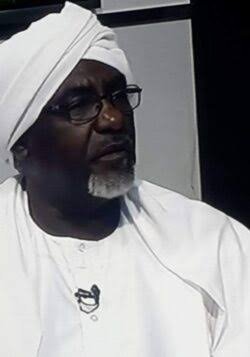
Words About Al-Tijani Abdel Qadir on the Day of His Passing
Dr Osman Abu Zaid
Last January, Al-Tijani Abdel Qadir Hamed mourned his friend Ahmed Kamal Al-Din, saying: “I have no doubt that he has left a great void among his brothers, colleagues and admirers, both inside and outside Sudan.” This is exactly what I say as I receive the devastating news this morning of Al-Tijani’s death… Al-Tijani has indeed left a great void among us.
We never knew the details of Al-Tijani’s clan or lineage, nor did we concern ourselves with such matters. It was as though we were following the example of Ibn Sirin, who spoke of the scholars of Hadith, saying that they did not use to ask about the chain of transmission; but when the fitna occurred, they said: “Name your men for us!”
Al-Tijani was from the Srayihab branch of the Al-Jawami‘a in Kordofan. He was born in the village of Umm Dam in 1951. He married his cousin, Najm Al-Din Abbas Faqir, of the Omda Abbas Faqir family in Ummli Al-Mahass.
In the early 1990s, he served as Director-General of the Department of Islamic Foundations and Orientation in Higher Education. However, he did not remain in the position for long, as he was seconded to work at the International Islamic University Malaysia in 1996.
Professor Al-Tijani left behind a rich legacy of Islamic thought, as well as journalistic writings distinguished by exceptional quality, soundness and depth.
I often return to an article of his entitled “Historical Contributions and Strategic Understanding”, which resulted from a series of conversations with a group of prominent Sudanese politicians. He and Abd Al-Mahmoud Al-Kurunkiy met them after receiving advice from Sheikh Muhammad Sadiq Al-Karuri when they had just graduated: they were to visit a number of these politicians and listen to them.
He and his brother Abd Al-Mahmoud came away with a wealth of mature ideas, which Al-Tijani distilled into a remarkable article. Perhaps the most profound conclusion they reached was that this tour was an exercise in understanding the other, and that understanding was possible because everyone shared many common intellectual foundations.
They concluded that “in reality, we have only one homeland, and ultimately we must learn how to live in it together.” Al-Tijani went further, saying: “The Unionists and the Umma Party do not differ greatly from us.”
Al-Tijani was a thinker of exceptional calibre, and his book Foundations of Political Thought in the Holy Qur’an is perhaps one of the finest works in its field.
This is not a subject that lends itself to hurried writing, and perhaps we shall return to it, particularly the change in his political allegiance towards the end of his life—a matter liable to misunderstanding.
At a certain stage of life, a person may develop a comprehensive outlook and consequently retreat from partisan commitment or organisational allegiance. This is something that can be “understood”. What is always important, and what ultimately matters, is general allegiance to Islam and Muslims, rather than allegiance to a particular banner or insignia. Otherwise, what meaning would there be in the slogan: “There is no allegiance to anyone but Allah”?
I must also recount here an amusing episode from the life of Al-Tijani Abdel Qadir: the story of how Bolad and Al-Tijani escaped from Dabek detention centre during our time there.
Dabek Prison lies approximately 20 kilometres north of Al-Jili, and around 80 kilometres from Khartoum.
The prison was built close to the Nile, so its water supply came through a pipe that filled the tank from which we obtained water for ablution, bathing, and drinking.
I remember that a huge snake once entered the prison through this pipe. The incident broke some of the monotony of prison life. Very little ever disturbed that monotony except the arrival of a new detainee or the release of another, although releases were rare.
The event that brought real excitement and vitality to our days in detention came later.
One day, we received a new detainee: Al-Tijani Abdel Qadir Hamed, who was Acting President of the Students’ Union at the University of Khartoum. We learned that the security officers who had delivered him to the prison had not recognised him because he had given them another name—perhaps Ahmed Abdel Karim, if my memory serves me correctly.
A few days later, news spread through the detention centre that Al-Tijani had successfully been smuggled out of the prison, together with Dawoud Yahya Bolad.
The prison administration conducted roll call twice a day, once in the morning and again in the afternoon. A whistle would sound, and we would sit in rows of five, with five men in each row. Two soldiers would come and count us, then leave once they had confirmed that the numbers were complete.
Strangely, on each of the two days following the escape of the two brothers, Bolad and Al-Tijani, the number of detainees was complete, because a deception operation was being carried out.
Usually, when the numbers didn’t match, one of the soldiers would enter the dormitories. He might find a sick man confined to his bed, or knock on the bathroom doors to make sure that someone was inside.
A wall separated one bathroom from the next, but it did not reach all the way to the ceiling. One of the detainees would lie across the wall, and when the soldier approached, he would make a noise suggesting that there were two people inside.
They would also make it look like someone was lying beneath a blanket on one of the beds. Malaria often kept someone in bed and kept them from attending roll call.
On the morning of the third day, the count was short by two.
The soldier quickly went to the office, brought back a register and began calling out the names. When he called the name of Brother Dawoud Yahya Bolad and repeated it, silence descended.
At that point, the soldier—‘Am Wanadiya—made a comical gesture. He put his hands beneath his chin and moved them up, as if to say: how could a grown man with a beard have escaped from prison?
They then called the name Ahmed Abdel Karim, but no one answered…
Dabek Prison had a lower wall than Kober Prison, topped with barbed wire. Kober’s wall, despite its considerable height, had a walkway along the top on which the sentry (al-daidaban) would patrol back and forth between the prison towers, with their gloomy yellow searchlights.
I never learned the details of the escape plan. Still, I later learnt that one of them had distracted the sentry by sitting beneath the tower and engaging him in conversation, keeping him occupied and away from his surveillance duties. They then managed to secure a rope to the wall, climb up it and descend on the other side.
I asked Brother Al-Tijani Abdel Qadir how they had reached Khartoum. I had heard that he had been suffering from malaria and that the reason Bolad had escaped with him was to assist him while walking and carry him if necessary.
Al-Tijani told me: “I was not suffering from malaria or any other illness. The late Bolad’s coming out with me was an additional idea. He had been the elected president of the union and had been arrested before me. I was serving as acting president outside. Some of the brothers therefore thought that, if it were possible to escape from detention, why not leave together, so that if one of us were rearrested, the other could take his place.”
Brother Al-Tijani continued:
“As for leaving Dabek Prison and reaching Khartoum Bahri, we walked the entire way on foot. It took between four and five hours of continuous, brisk walking. We did not speak, nor did we approach the tarmac road, so that no one would see us.
“When we reached Bahri, with the first signs of dawn appearing, we knew that, by Allah’s grace, we had escaped. The problem, however, was that we had no money to pay the bus fare.
“We flagged down one of the lorries heading towards Omdurman. We reached Omdurman and went to a house for single men (‘azaba) that I already knew.”
[End]
May Allah have mercy on Brother Al-Tijani. We pray that He may place his record of deeds in his right hand, make his reckoning easy, and cool his grave.
“Indeed, we belong to Allah, and indeed to Him we shall return.”
Shortlink: https://sudanhorizon.com/?p=18149