

The Levy Crisis in Sudan: Will the New Decisions Put an End to Multiple Fees and Roadside Chaos?
Sudanhorizon – Nazik Shamam
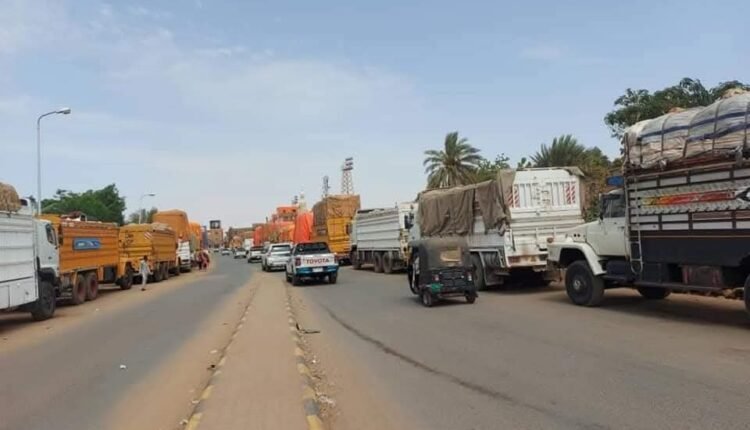
The Sudanese government is preparing to issue decisions concerning so-called “levies” in the coming days. During a Cabinet meeting held in Khartoum last Monday, the Minister of Information, Khalid Al-Ayesir, stated that the Council of Ministers had decided to review the issue of levies imposed on national highways, adding that imminent decisions would be issued in this regard.
For years, levies imposed along national roads have been among the most serious obstacles to the movement of exports and imports. The core of the problem lies in the multiplicity of bodies imposing these charges, particularly state-level authorities through whose territories goods pass from production areas to export outlets. These fees are not limited to state authorities; they also apply to federal bodies.
A surge in gum arabic fees
At the start of the new year, the National Forestry Corporation announced a fee increase on gum arabic for 2026, amounting to a 150 per cent rise compared to last year. Fees were raised from SDG 6,000 per quintal to SDG 15,000.
According to a circular issued by the Corporation and approved by its Board of Directors—of which Sudanhorizon obtained a copy—this increase falls under compensatory fees on forestry products and services for 2026.
The Head of the Gum Arabic Exporters’ Chamber, Ahmed Al-Tayeb Al-Anan, confirmed that any increase in fees would be reflected directly in the product’s overall cost. In previous remarks to Sudanhorizon, he explained that the US dollar exchange rate rose in 2025 from SDG 2,500 to SDG 2,600, an increase of four per cent, noting that forestry fee increases far exceeded the rise in the exchange rate.
Al-Anan revealed that total government fees on one tonne of gum arabic last year amounted to SDG 1,245,688, equivalent to 17 per cent of its total value. He added that the Corporation had imposed three new fees: forestry fees (from SDG 6,000 to SDG 15,000 per quintal), port fees per tonne (from SDG 12,000 to SDG 30,000), and additional storage charges.
He pointed out that these fees amount to USD 105 per tonne. By comparison, he said, the cost of exporting gum arabic from forests in Chad to the port of Douala in Cameroon does not exceed USD 17, expressing astonishment at the imposition of such burdens at a time when the country is in dire need of foreign currency resources.
Government justifications and market prices
In response, the National Forestry Corporation justified the increases. Its Director-General, Engineer Suleiman Moussa Suleiman Al-Safouri, outlined the breakdown of the imposed fees in a statement to Al-Ahdath newspaper: zakat of SDG 40,000 per quintal; Ministry of Finance fees of SDG 6,000 per quintal; local services fees of SDG 2,500 per quintal; a truck departure fee of SDG 100,000; a shipping card costing SDG 26,000; and standards fees of SDG 230,000 for large trucks and SDG 125,000 for smaller ones.
Al-Safouri also disclosed that gum arabic was achieving favourable prices, with the price of a quintal of “old hashab” ranging between SDG 590,000 and SDG 600,000, while new gum was priced between SDG 575,000 and SDG 580,000 per quintal.
Corruption and multiplicity of authorities
In a related context, an electrical appliances supplier in Port Sudan—who requested anonymity—argued that the problem with the levy stems from the sheer number of authorities involved, which opens the door for unofficial bodies to collect money illegally.
He stressed that this situation “opens the door wide to corruption”, as suppliers are forced to pay in order to clear their goods. He noted that each state imposes the same fee under the same name, often without issuing reliable official receipts.
Impact of the anticipated decisions
A member of the National Exporters’ Chamber Union, Mohannad Awad, believes that any move to abolish levies would help reduce the cost of both exports and imports. He explained that most existing levies are imposed at the state level, lack legal uniformity, and vary significantly from one state to another.
Awad said, “Previously, exports were completely exempt from road fees. Today, however, they are subject to high state-level taxes and charges, and even fees imposed under titles such as ‘supporting the Battle of Dignity’ in some states, like Gedaref, where they sometimes reach SDG 5,000 per sack.”
He concluded by noting that these charges—which include various taxes, quality fees and repeated zakat payments—increase transport costs and undermine the competitiveness of Sudanese products. He stressed that implementing a comprehensive decision to abolish levies would represent a lifeline for Sudanese exports.
Shortlink: https://sudanhorizon.com/?p=10833