

Sudanese Dialogue from Within: A Test of National Will in the Face of External Polarization
Cairo – Sudanhorizon – Sabah Musa
Attention is turning these days to the Preparatory Committee for the Sudanese Internal Dialogue, as one of the efforts aimed at opening a political path that places Sudanese people at the heart of the search for a way out of the crisis, away from regional and international polarization and the multitude of initiatives that have so far failed to end the war, now in its fourth year.
A National Vision
The committee’s task goes beyond bringing political and community forces together around one table. It also involves testing the Sudanese people’s ability to manage their differences themselves and formulate a national vision capable of ending the war and paving the way for a new political phase, amid internal complexities and external interventions that have made the Sudanese crisis one of the most complicated regional and international issues.
The committee faces a highly complex mission, beginning with expanding participation to include political and community forces, youth, women, native administration leaders, and intellectuals, and extending to developing practical proposals for ending the war, post-conflict arrangements, and rebuilding state institutions. The ultimate goal is to establish a political process based on Sudanese will rather than balances of power or external pressure.
However, the path toward dialogue is not straightforward. The committee faces objections from Sudanese political forces based abroad, which argue that internal dialogue during wartime does not provide sufficient conditions for an inclusive political process. Observers, however, believe that the rejection by some of these forces amounts to an attempt to undermine the dialogue because they do not recognize the legitimacy of the government and armed forces and fear that internal dialogue could reshape the political landscape away from forces based outside the country.
A Genuine Test
Supporters of the internal track, by contrast, argue that continuing to wait for consensus outside Sudan means leaving political decision-making hostage to foreign conferences and meetings. They maintain that no lasting peace can succeed unless it reaches Sudanese society itself and involves Sudanese people from all social and political backgrounds.
From this perspective, the importance of internal dialogue goes beyond simply bringing political forces together. It represents a genuine test of whether Sudanese people can reclaim ownership of their national decision-making and produce a consensus that transcends current alignments.
Between those who see dialogue as an opportunity to rebuild bridges among the components of society and those who fear it could become a mechanism for reproducing the crisis, the committee’s primary task remains to demonstrate that dialogue can be a means of ending the war rather than another arena for prolonging the crisis.
The Dialogue Committee
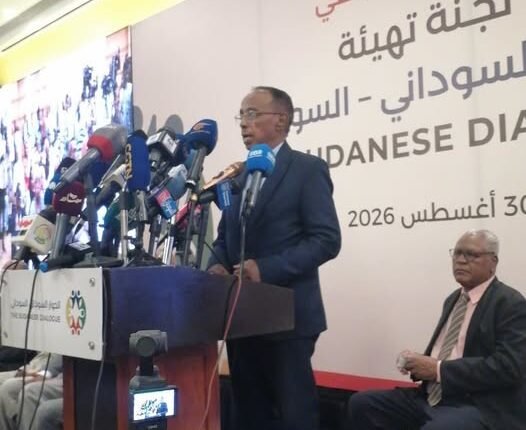
The Preparatory Committee for the Sudanese Dialogue is at the heart of this important test after beginning its activities in Khartoum to create a conducive environment and conduct consultations with political, civil, and community forces, paving the way for a vision for comprehensive dialogue.
The committee comprises 19 figures and says it seeks an independent and open dialogue accessible to different forces, while obtaining legal, political, and security guarantees to provide an environment that allows various parties to participate.
Nevertheless, the road to dialogue remains fraught with challenges, particularly following the rejection of the process by civil and political forces abroad. These groups argue that holding dialogue in areas under army control and under the auspices of the existing state does not, in their view, provide sufficient neutrality. They have called for a ceasefire and an independent political process to precede dialogue.
Observers believe these forces are less interested in a dialogue involving Sudanese people from all backgrounds than in a formula that grants them alone the right to speak on behalf of civil forces and the Sudanese people. In this sense, dialogue from within Sudan, with the participation of forces present on the ground, represents a challenge to their political project.
Necessity and Differences
Dialogue from abroad, meanwhile, remains more suitable for these forces because it allows them to retain their role as political representatives without facing a genuine test before the Sudanese public and forces inside the country.
This is where the contradiction in the Sudanese scene begins: all Sudanese speak of the need for dialogue, but they disagree over who should call for it, where it should be held, who should participate, and what should precede it.
While forces inside Sudan argue that the continuation of the war should not be a reason to obstruct dialogue, other forces believe that dialogue during wartime could become an incomplete political process or a means of reproducing existing balances of power.
A Dual Responsibility
The importance of this task lies in the fact that the success of dialogue will not be measured by the number of participants, but by its ability to produce a consensus capable of addressing the roots of the crisis.
The committee therefore faces a dual responsibility: convincing those inside Sudan that dialogue does not mean excluding anyone, while convincing those abroad that dialogue is not merely a political process for rearranging power.
The committee’s success also requires broadening the concept of participation so that it is not limited to traditional political parties and forces, but includes native administrations, trade unions, women, youth, civil society, intellectuals, academics, and social forces that have remained outside decision-making circles.
The most important question at this stage is therefore not simply whether dialogue will succeed, but whether it can become a genuinely Sudanese dialogue.
Ultimately, the committee’s success will not be measured merely by its ability to convene a conference, but by its ability to answer the more difficult question: Can it bring divided Sudanese together around Sudan’s interests, or will political divisions once again turn dialogue from a means of ending the crisis into a new crisis?
Arrangements for Dialogue
Diplomat and researcher in regional and international affairs Ambassador Abdel Mahmoud Abdel Halim told Sudanhorizon that all African conflicts have taken a long time to resolve, and that political dialogue eventually took place, leading to peace in a number of cases.
He stressed that Sudan is not isolated from these experiences, adding that following a military victory, arrangements for dialogue and a political solution would be necessary.
He said the committee had done well by describing itself as a “preparatory” committee whose purpose is to create the necessary conditions, predicting that its mission would neither be a quick process nor something that could be completed simply to “cross the bridge.” Rather, it would require time for political solutions to the “cursed war” to mature.
Negative Factors
Abdel Halim identified two negative factors facing internal dialogue.
The first is that Sudanese people have lost confidence in Sudanese solutions. The second is that the interests of foreign countries have come to exert significant influence over the Sudanese scene.
He said the Quad looks at what it wants from Sudan rather than what Sudanese people want, considering this a genuine challenge to any Sudanese political process.
A Positive Factor
At the same time, Abdel Halim identified a positive factor for internal dialogue: it has shifted the Sudanese public mood toward seeking dialogue.
He described this as an “important qualitative shift” in the course of the crisis.
“I do not expect the internal dialogue process to end overnight,” he said, stressing the need to work toward establishing post-war Sudan.
He warned against entering into political power-sharing arrangements, saying such arrangements could become a “broad title for another war.” What is required, he argued, is lasting peace rather than a temporary settlement that ends military operations only to reproduce the causes of conflict in another form.
Openings for External Intervention
Abdel Halim believes that the rejection of the dialogue process by Sudanese forces based abroad will affect the progress of internal dialogue.
He noted that some groups rely on these external actors for protection, adding that Sudanese people have lost some of their internal agency.
He argued that the external factor itself should be one of the issues addressed in the dialogue, including discussion of what Sudanese people can do about it so that openings are not left for external parties to interfere in Sudanese affairs.
He further noted that some reactions opposing the dialogue reflect the positions of external parties more than those of the people expressing them. In his view, this requires treating the external dimension as part of the crisis that should itself be addressed within the dialogue.
A National Mission
Abdel Halim called on members of the dialogue committee to recognize that their mission is a national responsibility that rises above personal inclinations. He urged them to set aside previous affiliations and act as officials entrusted with a mission that transcends political alignments.
He also advised committee members not to rush into media appearances or public statements before matters have matured, and to avoid the pursuit of “social prestige,” which could complicate the political landscape and affect the dialogue process.
He stressed the need to study various international experiences, particularly African experiences in political dialogue and conflict resolution, citing South Africa, Sierra Leone, and Liberia, as well as Sri Lanka and Colombia.
Studying these experiences, he explained, does not mean copying them wholesale, but rather learning from their tools and the reasons behind their successes and failures and adapting them to Sudan’s particular circumstances.
He also called on the committee to send clear messages to the international community aimed at giving “Sudanese ownership” of the dialogue a genuine opportunity and encouraging the international community to support Sudanese solutions rather than impose political tracks from abroad.
He advised committee members not to rush results and instead to work calmly and patiently, noting that building consensus in a country exhausted by war and divisions requires time and a considerable degree of political flexibility.
A Volunteer Committee
For his part, Al-Tayyar newspaper Editor-in-Chief Osman Mirghani explained that the committee is voluntary and was formed on its own initiative, with its task limited to creating the conditions for Sudanese-Sudanese dialogue.
Mirghani, a member of the dialogue committee, told Sudanhorizon that the dialogue is proceeding along two tracks—political and societal—without excluding or exempting any political force or social component.
He added that the ongoing discussions at this stage aim to build consensus among political and social components on the details of the dialogue conference, including the nature of the conference, the participating parties, and its agenda.
He stressed that all political and social forces themselves will determine the dialogue’s agenda, the participating parties, and the committee responsible for managing the dialogue.
“The current committee’s task goes no further than creating the necessary conditions to reach this stage,” he said, adding clearly: “Our only task is to create the conditions for dialogue.”
Shortlink: https://sudanhorizon.com/?p=17568