

Sudan: Petroleum Products… Crisis in Search for Solutions
Sudanhorizon– Nazik Shamam
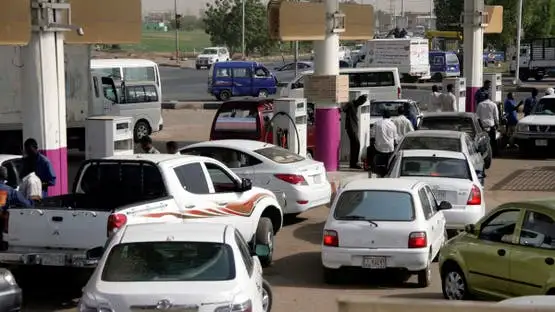
Long queues of vehicles stretching out in front of gas stations have become a common sight in the Sudanese capital, Khartoum.
For several months, Sudan has struggled to secure a sufficient supply of petroleum products. The situation is further exacerbated by the increasing number of Sudanese returning from neighboring countries to their home regions, following the stabilization of security conditions across most parts of the country.
Paradoxically, as the rate of returnees rises, the quality of services—most notably fuel availability—deteriorates. Fuel is the cornerstone for all essential services, including transportation, logistics, electricity, and healthcare.
Compounding the crisis is the government’s own inconsistent approach to fuel imports. At times, it signals an intention to leave the matter to the private sector; at other times, it reverts to state-led importation. Yet, within a week, it might announce a desire to end state monopolies—a clear indication that the government has neither reached a firm decision nor defined a coherent strategy for handling this thorny issue.
According to the Central Bank of Sudan’s statistical brief on foreign trade, imports of petroleum products during the first half of 2026 amounted to approximately $1.495 billion—out of a total import bill of $4.517 billion—accounting for roughly 33% of the total import expenditure. Within this figure, gasoline (petrol) accounted for approximately $374 million, while diesel (gasoil) accounted for about $923 million. All these factors raise questions that require clarification: What are the options available for supplying various petroleum products, and what obstacles hinder this process? Furthermore, is the failure to provide these products due to the suppliers themselves, or does the blame lie with the Ministry of Energy for failing to fully liberalize the commodity?
Economic expert Haitham Fathi states that the liberalization of fuel prices in Sudan was fully implemented in June 2021, with the responsibility for setting prices—on an ongoing basis—transferred to the companies that import petroleum products.
He added that the decision at the time abolished state-mandated pricing for both gasoline and diesel. This was part of what the government of former Prime Minister Abdalla Hamdok termed a “state policy aimed at reforming the national economy and establishing a framework that would enable both state institutions and the private sector to engage with international financial institutions.”
In a statement Fathi explained that pricing process is determined by import costs—which account for 71% to 75% of the final fuel price—along with transportation costs, port fees, value-added tax (VAT), and the profit margins of distribution companies. Together, these additional costs make up 25% to 29% of the retail price paid by the consumer.
He noted that those managing the economy opted for the easiest and quickest solutions without considering the adverse consequences of raising fuel prices. Such measures disproportionately harm low-income individuals, fueling social instability—especially when families are already unable to secure their basic needs. Consequently, these price hikes generate psychological stress, despair, and a sense of oppression across economic, political, and social spheres. He emphasized the necessity of postponing any new decision to liberalize fuel prices, citing social considerations and the need to avoid placing further burdens on citizens given the current economic situation—even if there is an economic justification, such as a shortfall in state revenue coupled with rising expenditures. He noted that the government should have adopted a gradual approach to allow citizens to adapt, especially considering the difficult circumstances currently faced by the Sudanese people.
He also called for greater efforts from the banking sector, in coordination with relevant ministries and authorities, to secure the necessary foreign currency to procure petroleum products—ensuring the process is sound, efficient, transparent, and strictly regulated. Furthermore, he urged continued efforts to attract more investment and remove obstacles facing both local and foreign investors in the energy and fuel sectors.
He proposed the development of an integrated digital system that connects all stakeholders in the petroleum products sector through a unified platform. This system would encompass production, importation, transportation, storage, distribution, retail fuel stations, and financial settlement. By linking operational processes with financial flows, it would provide a consolidated view of data across the entire value chain, thereby enhancing planning and decision-making while strengthening oversight and transparency.
Meanwhile, an oil sector expert—who requested anonymity—observed that the importation of petroleum products has long been plagued by a persistent “crisis syndrome.”
He explained that the only exceptional period in the country’s history free from such crises was the era between 1999 and 2011, when the nation was actively producing and processing its own oil. The source identified the causes of the crisis in the supply of petroleum products as stemming from external factors—specifically, the closure of waterways due to political repercussions, similar to the situation with the Suez Canal in the 1970s. This forced vessels to reroute via the Cape of Good Hope, which in turn drove up shipping costs.
He noted that a similar external factor has recurred this year, following the closure of the Strait of Hormuz by the Iranian side, which has further increased shipping and insurance costs, as well as transit times.
In his remarks , the source pointed out that internal factors have also deepened and intensified the country’s fuel crisis. These include a severe shortage of foreign currency—exacerbated by a decline in exports—resulting from the disruption of production across large parts of the country. Export commodities, such as sesame and gum arabic, have been negatively impacted by wars, conflicts, and the displacement of the population.
The oil expert revealed that the solution lies in establishing long-term contractual agreements with other nations or corporations. However, he cautioned that such a step would require guarantees that the current government may not be in a position to provide—a situation that forces a reliance on the private sector, subjecting the situation to fluctuations in the dollar exchange rate, which in turn leads to price instability.
It was noted that such price volatility exerts pressure on the government to fully liberalize prices.
The restoration of the Sudanese Petroleum Corporation is seen as part of the solution to the crisis; the corporation possesses the expertise to manage such situations and serves as a legal entity empowered to take action and enter into contracts.
It is noted that some individuals on social media have called for a return to the decisions of June 2021—specifically, for the state to temporarily withdraw entirely from the petroleum products market, leaving it to the private sector under agreed-upon, fair, and transparent criteria. This would remain in effect until the state concludes its existing contracts with international companies and those companies begin the supply of petroleum products.
Shortlink: https://sudanhorizon.com/?p=19145