

Sudan and the Upcoming African Union Summit: Is a Breakthrough Possible?
Addis Ababa – Sudanhorizon
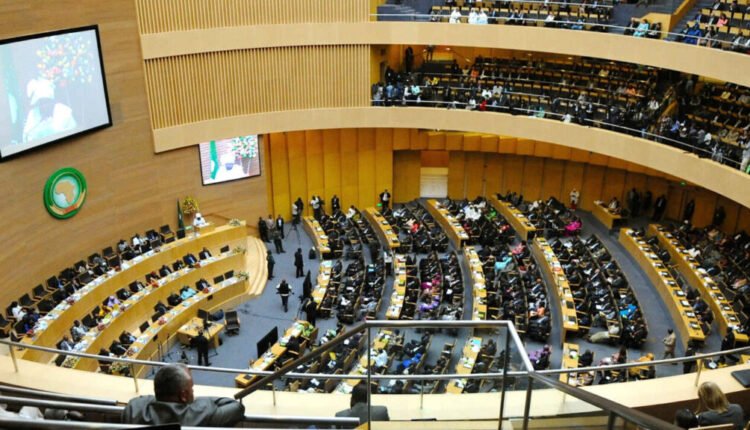
Meetings of the African Union Executive Council (Foreign Ministers) begin today (Wednesday) in the Ethiopian capital, Addis Ababa, and will continue until tomorrow, in preparation for the 39th Ordinary Session of the Assembly of the Union, scheduled for the 14th and 15th of this month. Prior to this, the Permanent Representatives’ Committee convened and submitted its report to the Executive Council.
First Participation
While “the situation in Sudan” remains one of the key issues under discussion by the African Union Peace and Security Council (PSC), and despite Sudan’s suspended membership, Sudanese diplomacy has succeeded in securing the participation of the Minister of Foreign Affairs, Ambassador Mohi El-Din Salem, for the first time in five years in the consultative session preceding tomorrow’s (Thursday) closed meeting of the PSC, which will be chaired by Egypt.
Sudan’s Permanent Representative, Ambassador Al-Zain Ibrahim, had previously participated twice at the ambassadorial level. Those engagements yielded tangible outcomes, most notably the rejection of parallel arrangements, reaffirmation of Sudan’s unity and territorial integrity, the disappearance of language equating the national army with the rebel militia, and recognition of the Sovereignty Council and the government as the sole legitimate representatives of the Sudanese state.
The Minister in Addis Ababa
Sudanhorizon has learned that the Minister of Foreign Affairs and International Cooperation, Ambassador Mohi El-Din Salem, has already arrived in Addis Ababa and has begun a series of meetings with his counterparts from member states of the Peace and Security Council. He is also expected to hold talks with officials at the African Union Commission as part of his current engagement. He will subsequently travel to Germany to participate in the Munich Security Conference, alongside Prime Minister Dr Kamil Idris, who departed earlier today.
Composition of the Peace and Security Council
The structure of the African Union Peace and Security Council, which began operating in 2004, closely resembles that of the United Nations Security Council. It comprises fifteen members representing the continent’s five regions. Each region elects one member for a three-year term, while the remaining ten serve two-year terms, ensuring continuity of institutional knowledge and sustained attention to regional priorities.
However, the distribution of seats among Africa’s five regions is not equal, reflecting the varying number of states within each region. The Council allocates two seats to North Africa, four to West Africa, and three each to East, Central, and Southern Africa.
Major Changes to the Council’s Composition
The current composition of the Peace and Security Council—set to remain in place until the end of this month, marking the conclusion of the upcoming summit—includes Algeria and Egypt (North); Ethiopia, Tanzania, and Uganda (East); Cameroon, the Democratic Republic of the Congo, and Equatorial Guinea (Central); Nigeria, Côte d’Ivoire, The Gambia, and Sierra Leone (West); and Eswatini, Angola, and Botswana (South).
This configuration will undergo significant change, with two-thirds of its membership—ten countries—losing their seats at the end of the current summit. Ten new members will be elected, while one country from each region will retain its seat, as previously indicated.
Egypt’s Departure and Algeria’s Continuity
At the end of the current African Union cycle, Algeria, Ethiopia, Cameroon, Nigeria, and Eswatini will retain their seats on the Peace and Security Council as representatives of their respective regions. Ten new members will be elected.
According to Sudanhorizon’s sources, Egypt—currently chairing the Peace and Security Council for this month—will lose its membership at the end of the month. A new North African member will be elected among the ten incoming states, with competition reportedly centred on Morocco and Tunisia
A Possible Breakthrough?
The decision to suspend Sudan’s membership, taken in October 2021, was issued by the Peace and Security Council, the principal body responsible for such determinations. While diplomatic sources speaking to Sudanhorizon suggest it is unlikely that the PSC will reverse its previous decision at tomorrow’s meeting, it remains possible that the diplomatic efforts currently led by Sudan could yield a positive outcome before the end of this month—particularly in light of the Council’s planned visit to Sudan under Egypt’s presidency.
Shortlink: https://sudanhorizon.com/?p=11175