

Maps: Where Is the Sudanese Army Advancing, and Where Are the New Fronts?
Sudanhorizon – Agencies
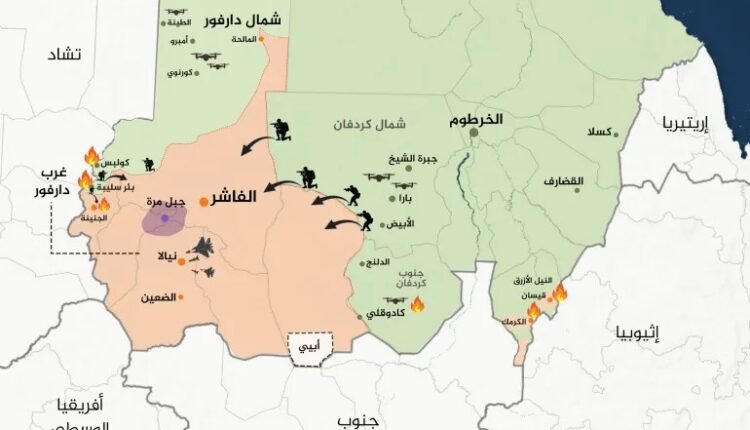
The battlefield map in Sudan is witnessing a notable expansion in areas controlled by the Sudanese Armed Forces and their allied forces across the central states, Kordofan, and Darfur, while the Rapid Support Forces (RSF) are gradually losing ground and, in turn, intensifying attrition attacks using drones against cities.
The Sudanese Army has maintained full control for more than two years over the capital, Khartoum, and its three cities—Khartoum, Omdurman, and Bahri—in addition to all the northern, central, eastern, and southern states.
Kordofan Fronts
The army continues its advance across the Kordofan region, achieving major strategic gains, most notably securing the entire National Export Road, the vital artery linking Khartoum with El Obeid, the capital of North Kordofan State. This follows significant advances along the North Kordofan axis, particularly in Jabra Al-Sheikh, Bara, Umm Sayala, and other areas.
Jabra Al-Sheikh is located in North Kordofan, approximately 160 kilometers north of El Obeid, along the Export Road and near the former Arbaeen Road.
Recent operations have completely broken the siege of El Obeid. The Joint Force is currently conducting extensive clearance operations to encircle and eliminate RSF pockets positioned along the city’s western and southwestern axes.
On August 14, the army repelled an RSF ground assault on the areas of Jabal Hashaba and Umm Arda, southwest of El Obeid.
On August 12, Hamad Mohamed Hamid Khalifa, the governor of Kordofan appointed by the so-called “Founding Government” affiliated with the RSF, announced his defection, accusing the group of fueling tribal and racial conflicts.
On August 19, field sources reported the surrender and defection of another RSF group and its decision to join the Sudanese Army.
The humanitarian crisis has worsened as the displacement camp in El Obeid expanded over a two-week period following the displacement of large numbers of people from the Al-Jamama area at the end of July due to fighting.
The army also succeeded in breaking the prolonged siege imposed by the RSF and the Sudan People’s Liberation Movement–North on the strategic cities of Kadugli and Dilling in South Kordofan. The forces are now moving to secure the outer axes and turn RSF pockets into isolated and defensively encircled areas.
Darfur Region
The Joint Force of Darfur armed struggle movements allied with the army is making intensive ground advances aimed at restricting RSF supply movements. The strategy is focused on cutting supply lines before moving to seize the RSF’s last strongholds in the region.
On June 30, the Joint Force announced that it had regained control of Kulbus, located approximately 160 kilometers north of El Geneina on the border with Chad.
Kulbus is considered a strategic point linking West and North Darfur, with supply routes between El Geneina and the northwestern areas passing through it.
On August 5, military sources announced the killing of Major General Mahdi Adam, known as “Jabal Moon,” commander of RSF Group 128 and the western axis, during clashes in the areas of Hajar Al-Marfaein and Bir Suleiba.
Adam was one of the RSF’s prominent field commanders. He assumed command of Group 128 after being promoted to the rank of major general and had previously served as commander of the RSF artillery during its deployment in Khartoum.
Bir Umm Suleiba
On August 8, the strategic area of Bir Umm Suleiba came under an RSF assault, the second of its kind in less than a week.
According to Joint Force spokesman Major Mutawakkil Abu Ja, speaking to Al Jazeera Net, the force succeeded in destroying more than 38 combat vehicles and capturing another 27, in addition to killing the commander of the attacking force and a number of its fighters.
These developments coincided with escalating waves of displacement. The International Organization for Migration (IOM) reported on July 2, 2026, that more than 6,000 people had been displaced from Kulbus and three neighboring villages toward Chad.
On August 4, more than 6,650 people from 11 villages in Sirba locality were displaced amid escalating clashes in Bir Suleiba and surrounding areas.
Field sources indicate that the Sudanese Army and its allied Joint Force are pursuing a gradual-advance strategy, taking control of positions surrounding El Geneina before moving toward the city itself, described as the RSF’s last stronghold in Darfur.
The Triangle Area
This is a strategic border area linking Sudan, Libya, and Chad, located south of the Egypt-Sudan-Libya border triangle around the Jebel Al-Awainat area. It has witnessed rapidly developing battlefield activity and has become an exposed and dangerous attrition front for the RSF.
The Sudanese Air Force is maintaining a tight aerial blockade over desert routes linking eastern Libya with northern Darfur to prevent the delivery of supplies.
Recent operations in the area reportedly resulted in the destruction or disabling of approximately 200 combat vehicles and supply trucks, along with the killing of dozens of RSF fighters attempting to infiltrate through the desert.
The Joint Force also carried out carefully planned ground ambushes in strategic areas such as Bir Marqi, thwarting multiple infiltration attempts and preventing the smuggling of weapons and supplies to besieged groups.
Southern Blue Nile
This front is particularly significant because of its location along the Ethiopian border, near the Grand Ethiopian Renaissance Dam (GERD).
Heavy fighting has taken place in the areas of Geissan and Kurmuk between the RSF and its allies on one side and the Sudanese Army on the other.
The area has witnessed shifts in control. The RSF announced that it had taken control of Geissan and Kurmuk this month, after the army had regained control of Kurmuk in July.
Sudanese authorities accuse Ethiopia of providing logistical assistance and training camps for RSF personnel inside its territory in the Benishangul-Gumuz and Asosa areas.
Field reports also indicate that recent RSF attacks on Geissan and Kurmuk relied on drones and supply routes crossing the neighboring Ethiopian border.
According to independent reports, including a report by the Yale Humanitarian Research Lab, military activity has been observed at Ethiopian bases near the border consistent with the provision of military and logistical support to the RSF.
The fighting has displaced more than 200,000 people from Kurmuk, Geissan, and other areas of the region.
With the army advancing in Kordofan and Darfur, while the RSF conducts drone attacks around El Obeid and in southern Blue Nile, questions remain: Is a decisive battle in Darfur approaching, or will the war turn into a prolonged war of attrition across the desert and open borders? And will the army succeed in capturing El Geneina in West Darfur before the humanitarian crisis becomes an unbearable catastrophe?
Source: Al Jazeera
Shortlink: https://sudanhorizon.com/?p=17403