

Cabinet Affairs Minister : Sudanese PM Will launch a Peace Initiative From Within UNSC
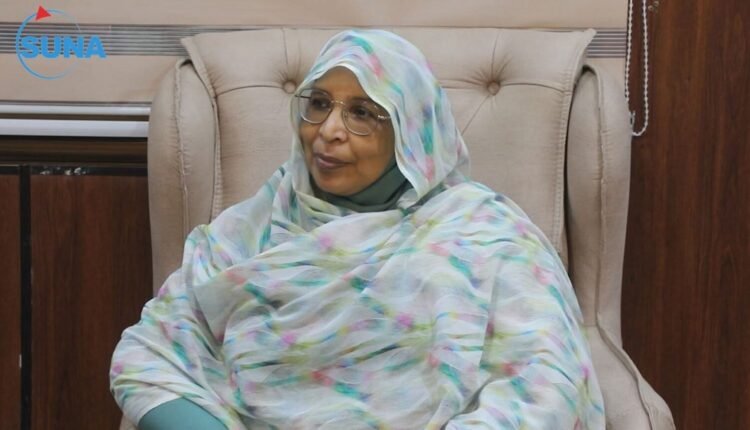
Cairo was the scene for the 2nd meeting of the Russia-Africa Partnership Forum, Friday and Saturday. This meeting was attended by more than 50 African states, in addition to Russia. Sudan participated with a high-level delegation led by the Minister of Cabinet Affairs, Dr. Lamia Abdel Ghaffar. Sudan’s participation in this major international forum was significant as it provided an opportunity to explain the Sudanese crisis, the crimes and violations committed by the Rapid Support Forces militia, and to demand its designation as a terrorist entity. On the sidelines of the meeting, we met with Dr. Lamia Abdel Ghaffar and discussed with her the latest developments in the country.
Following is the text of the interview conducted by: Sabah Moussa
– What benefits did Sudan gain from its participation in the Russia-Africa Forum meetings?
– Minister: Through this forum, Sudan was able to amplify its voice to the African continent and the world, addressing the complex humanitarian situation and the human rights violations perpetrated against civilians by the Rapid Support Forces militia. We also called upon the conference to designate this group as a terrorist organization that must be held accountable, along with its regional sponsors. Furthermore, we emphasized the importance of strengthening the Russian-African-Sudanese partnership to achieve economic growth and expand Russian investments in renewable energy, mining, and oil exploration.
– What is Russia’s significance to Sudan, and to what extent can it serve as an alternative to other international powers in resolving the Sudanese crisis?
-Minister: Since the beginning of the war on Sudan, the Russian Federation has supported Sudan’s sovereignty and territorial integrity. This support has been evident in its stance at the UN Security Council and in all international and regional forums. Sudan places great importance on the emergence of new players, such as the BRICS group and other economic blocs, which mitigate the dominance of a uni-polar world.
– What were the most important meetings you held on the sidelines of the gathering, and what was the objectives?
-Minister: The second ministerial conference was an important opportunity to meet with His Excellency President Abdel Fattah al-Sisi, President of the Arab Republic of Egypt, who, in his address to the African foreign ministers, emphasized the importance of strengthening economic relations with the Russian Federation and opening up investment opportunities in the oil and energy sectors and technology transfer. He also called on the African continent to renounce violence and conflicts in order to enjoy peace and security, which are essential for stability and prosperity, and to enable Africa to play a significant and influential role in the world as one of the richest continents in terms of natural and human resources. We also met with the foreign ministers of Angola, Equatorial Guinea, and Algeria and discussed with them the lifting of the suspension of Sudan’s membership in the African Union, especially since an AU delegation is scheduled to arrive in Port Sudan before the end of this year to assess the performance of the civilian government and submit a report to the Union. The importance of Algeria, Angola, and Equatorial Guinea stems from their membership in the African Union Peace and Security Council, as well as Angola’s membership in the Troika and Algeria’s membership in the UN Security Council. We also briefed the three ministers on the humanitarian situation in the country and the events in El Fasher, and stressed the necessity of designating the Rapid Support Forces as a terrorist organization. Algeria promised to reopen its embassy in Khartoum immediately, upon the government’s return there.
– The meeting with Dr. Badr Abdel-Aty, the Egyptian Foreign Minister, was a reaffirmation of Egypt’s red lines in Sudan… How did you view these lines?
-Minister : The Sudanese government and people received these lines with great relief and welcome, as the Sudanese leadership affirmed its openness to the efforts of brotherly and friendly countries to establish peace and end the war.
– How do you interpret Egypt’s insistence on operating within the framework of the Quartet despite Sudan’s rejection of it? How do we interpret the Saudi, Egyptian, and American moves in Sudan? Are they based on the Quartet, or are they an attempt to find a new path to resolve the crisis? And can the government reconsider the Quartet?
– Minister : There is a new initiative based on the Quartet, namely President Donald Trump’s initiative. This is a very important initiative that has opened the door for Sudan to communicate directly with America through its special representative, with Saudi understandings led by His Royal Highness Prince Mohammed bin Salman, Crown Prince of the Kingdom of Saudi Arabia, and His Excellency President Abdel Fattah al-Sisi, President of the Arab Republic of Egypt.
– What are the reasons for Prime Minister Dr. Kamil Idris’s visit to the United States, and is it true that he will lead negotiations with the United Arab Emirates?
– minister: the Prime Minister Dr. Kamil Idris’s visit to New York comes within the framework of the government’s intensive diplomatic efforts during this period. It is a visit to the United Nations, led by Secretary-General António Guterres, to discuss the UN’s role in establishing peace and delivering humanitarian aid to those affected by the war in Sudan.
– Is it true that the Prime Minister will lead negotiations with the UAE during his current visit to the United States?
– Minister: Anything is possible… but what I know is that Prime Minister Dr. Kamil Idris wants to launch a peace initiative from within the corridors of the Security Council.
– Is the government seeking an internal Sudanese-Sudanese dialogue, and what progress has been made on this issue?
-Minister : The Sudanese government is exerting every possible effort to create opportunities for national political forces to engage in a serious political process that contributes to establishing peace. The Prime Minister has conducted extensive consultations with a large number of political leaders inside and outside Sudan to agree on a unified political vision that will form a political path.
– What is the government’s comment on the meeting of several political forces in Nairobi and their demand to designate the National Congress Party and the Islamic Movement as terrorist organizations at this time, without including the Rapid Support Forces?
-Minister : These are desperate attempts to create false narratives about the Sudanese reality and the battle for dignity. The world has witnessed the massive popular support of the Sudanese people for their armed forces and supporting forces. What they fear is that this popular support will be the beginning of preparations for a transitional phase aimed at achieving stability and peace in Sudan.
– What are your regional and international efforts to designate the Rapid Support Forces as a terrorist organization?
-Minister There are multi-level diplomatic efforts underway, most notably those undertaken by Foreign Minister Ambassador Mohi El-Din Salem with heads of state and his counterparts, through Sudanese embassies and diplomatic missions, and also through organized visits by special representatives of European Union countries and UN organizations and agencies. This is in addition to the efforts of the Ministry of Culture and Information, under the leadership of its distinguished Minister, Khaled Al-Aisir, which, through all traditional and modern media outlets, highlights the violations and atrocities committed by the terrorist rebel militia against civilians and unarmed citizens in various regions of Sudan.
– We would like to ask about the humanitarian situation in the country, particularly concerning the displaced people of El Fasher in Ad-Dabba, Tawila, and Kordofan. Is the government able to meet their needs, or do they still require international assistance?
– Minister: The recent events in El Fasher were the most horrific since the beginning of the war. The city remained under siege for over 18 months, during which its residents suffered from hunger, disease, and torture. Despite UN Security Council Resolution 2637 calling for the lifting of the siege, the rebel militia disregarded these resolutions and continued to perpetrate all forms of torture, abuse, and killing, which they themselves documented and disseminated on social media.
The residents of El Fasher were displaced to northern Sudanese states, fleeing militia-controlled areas for areas under army control, where they found the security, protection, and care they sought after a journey of pain and suffering that lasted for days and nights. The humanitarian situation is complex, the response from organizations is weak, and the gap is significant, particularly in infrastructure services such as water and sanitation, as well as education and income-generating projects for camp residents.
– What about the relocation of the government to Khartoum? To what extent is the capital now ready to receive the state’s executive branch? And when will you return?
– Minister :The Prime Minister has directed the entire executive branch to relocate to Khartoum and begin operating from the capital at the start of the new year. The Ministry of Cabinet Affairs is working to ensure that all ministries have received their new headquarters in the capital by the end of December 2025. Furthermore, the Higher Committee for Environmental Preparation in Khartoum, led by Lieutenant General Ibrahim Jaber and the Governor of Khartoum, has completed its work on security arrangements, including the opening of police stations in all Khartoum neighborhoods and the restoration of electricity and water services. It has also prepared health and educational facilities and markets to guarantee a safe return for both the government and the citizens.
– We would like to shed light on the reconstruction of Sudan… Is the country ready for reconstruction now? When will the plan for this initiative begin, and which countries will be the most important partners in Sudan’s reconstruction?
– Minister: Indeed, the reconstruction file is among the top priorities of the Government of Hope, the government of Dr. Kamil Idris. A recommendation has been made to establish a High Commission for Reconstruction under the supervision of the Prime Minister. The Sudanese government welcomes the role of the Arab Republic of Egypt in reconstruction efforts through its public and private sector companies. It also welcomes contributions from our brothers and friends to rebuild what the war has destroyed in Sudan.
– One last question… It has been noticeable that the Foreign Minister has been absent from important visits and events recently. Could you tell us the reason for this absence?
– Minister : The Minister is suffering from a health issue and is currently recovering. His recovery period will be short, and he will return to his post in Port Sudan before the end of the year.
Shortlink: https://sudanhorizon.com/?p=9809