

“Blood on the Sand — and on the Hands!!”
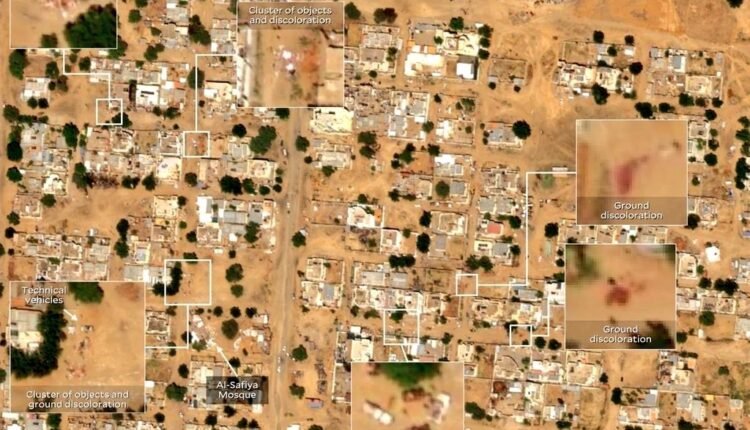
Sudanhorizon – by Mohammed Osman Adam
The UN News Bulletin has published a report titled “Blood on the Sand and on the Hands: The United Nations Condemns the World’s Failure over the Fall of Al-Fashir in Sudan”, written by Vibhu Mishra, a correspondent for UN News.
The title, as explained by the journalist, symbolises two images: “blood on the sand” refers to the mountains and sand dunes surrounding Al-Fashir, now soaked with the blood of civilians coldly murdered by the Rapid Support Forces (RSF);. In contrast, “blood on the hands” represents the stain of guilt left on the hands of the killers.
The article notes that senior UN officials warned on Thursday that the city of Al-Fashir has descended into an even darker hell after the RSF seized control of the capital of North Darfur following a siege of nearly 540 days, forcing tens of thousands to flee on foot amid reports of mass executions, rape, and famine.
In his briefing to the Security Council ambassadors, Tom Fletcher, the UN’s top relief official, said:
“Women and girls are being raped. People are being mutilated and killed — with complete impunity.”
He added: “We cannot hear their screams here, but — as we sit here today — the horror continues there.”
He went on to say that after overrunning the last major Sudanese Armed Forces stronghold in Darfur — which had held out for more than 500 days — RSF fighters went house to house, and there were “credible reports of large-scale executions” as civilians tried to flee.
Reports indicate that around 500 patients and their attendants were killed at the Saudi Maternity Hospital, one of several health facilities targeted in the fighting.
Mr Fletcher said:
“Tens of thousands of terrified, starving civilians have fled or are wandering from place to place — those who could escape. But the vast majority — women, children, and the elderly — face extortion, rape, and violence on the perilous journey.”
A Reign of Terror
Martha Pobee, Assistant Secretary-General for Africa, described the fall of Al-Fashir as “a major shift in the security dynamics”, warning that the repercussions for Sudan and the wider region would be “profound.”
She noted that fighting had already intensified in Kordofan, where the RSF captured the strategic town of Bara last week.
She added that RSF drone strikes are now targeting new locations across Blue Nile, South Kordofan, West Darfur, and Khartoum, warning that “the regional scope of the conflict is expanding.”
Ms Pobee told the Council:
“The risk of mass atrocities, ethnically targeted violence, and further violations of international humanitarian law — including sexual violence — remains alarmingly high.”
“Despite commitments to protect civilians, the reality is that no one is safe in Al-Fashir. There is no safe corridor for civilians to leave the city.”
The UN Human Rights Office has documented mass killings, summary executions, and ethnically motivated reprisals in both Al-Fashir and Bara. Ms Pobee reported that in Bara alone, at least 50 civilians were killed in recent days, including five Sudanese Red Crescent volunteers.
A History of Atrocities in Darfur
Mr Fletcher said:
“What is unfolding in Al-Fashir echoes the atrocities that engulfed Darfur twenty years ago” — referring to the horrors of the early 2000s that shocked the world and led to indictments by the International Criminal Court.
“But somehow, today we are witnessing an entirely different global reaction — one of indifference. This too is a crisis of indifference.”
He continued:
“Sudan’s crisis is, at its core, a failure to protect and a failure to uphold international law.
Atrocities are being committed with a shameless expectation of impunity… The world has failed an entire generation.”
Descent into Full-Scale War
The conflict in Sudan began in April 2023, when a long-simmering rivalry between the Sudanese Armed Forces (SAF) and the Rapid Support Forces (RSF) erupted into open warfare.
The RSF traces its roots to the Janjaweed militias, accused of atrocities in Darfur two decades ago, while the SAF represents the remnants of Sudan’s national army that dominated the country’s long-standing military rule from Khartoum.
After the overthrow of former President Omar al-Bashir in 2019, the two forces shared power in a fragile arrangement — but disputes over integrating the RSF into the national army ultimately triggered the country’s collapse.
What began as a power struggle has since evolved into a brutal war marked by ethnic killings, urban sieges, mass displacement, and famine conditions across large parts of Sudan.
Regional Spillover and Humanitarian Collapse
More than four million people have fled to neighbouring Chad, South Sudan, and the Central African Republic, straining humanitarian operations and heightening instability in already fragile border regions.
Inside Sudan, more than 24 million people — over 40% of the population — suffer from food insecurity.
The town of Tawila, about 50 kilometres from Al-Fashir, now hosts hundreds of thousands of displaced people from previous waves of attacks.
Mr Fletcher said:
“Our teams in Tawila are witnessing new arrivals traumatised and showing horrifying signs of malnutrition.”
Blood on the Sand and on the Hands!!
Mr Fletcher urged the Security Council to act with “immediate and decisive measures” to halt the atrocities, ensure safe humanitarian access, and stop the flow of weapons fuelling the war.
He told the ambassadors:
“I urge my colleagues to look at the latest satellite images of Al-Fashir — there is blood on the sand.”
“And I urge them to confront the world’s continuing failure to stop this — there is blood on the hands,” he said, referring to the victims’ blood on the hands and weapons of the militia.
Shortlink: https://sudanhorizon.com/?p=8386