

BBC Investigative Report Reveals Why the Militia Is Blocking Humanitarian Organizations from Entering El Fasher
Sudanhorizon – Agencies
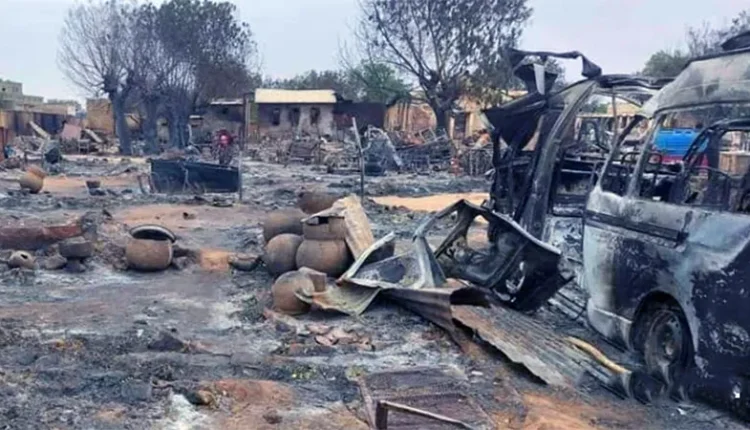
The BBC has conducted an investigation titled “Rapid Support Forces in Sudan Deliberately Targeted Hospitals,” which uncovers abuses committed by the Rapid Support Forces (RSF) militia against healthcare facilities and medical personnel in the city of El Fasher. The investigation presents compelling evidence that the RSF targeted health facilities and healthcare workers with the aim of depriving the city of these essential services and rendering it uninhabitable.
The findings reveal that the attacks were not haphazard or random, but rather systematic and persistent, intended to deny the population access to healthcare. The report reaches three key conclusions—which have also been endorsed by the UN High Commissioner for Human Rights, Volker Türk—namely: that the RSF militia has committed grave violations of international humanitarian law by targeting health facilities; that it has perpetrated crimes against humanity; and that it is currently blocking humanitarian and international organizations from reaching the beleaguered city—a move aimed at concealing evidence of other atrocities that may yet come to light, similar to the attacks on healthcare services.
Drawing on sources present on the ground in El Fasher, the BBC documented details of at least 43 separate attacks on hospitals and health facilities between May 2024 and October 2025, with some locations targeted on multiple occasions. Attacking healthcare facilities or medical personnel during armed conflicts is illegal under international law.
The investigation also reveals the scale of the toll taken on medical workers in this city, located in western Sudan. BBC report indicates that between April 2023 and October 2025, 120 people were injured, 55 were killed, and 10 were subjected to enforced disappearance or abduction. The BBC investigation, published earlier this week, presents evidence confirming that the Rapid Support Forces (RSF) systematically destroyed the healthcare system in the city of El Fasher—a process that unfolded during their prolonged siege of the city and their subsequent takeover of it in the Darfur region a year ago.
The BBC reported that Volker Türk, the UN High Commissioner for Human Rights, described these findings as “deeply alarming,” noting that the repeated attacks by the RSF on civilian infrastructure—including healthcare facilities—”constitute serious violations of international humanitarian law and may amount to war crimes.”
The BBC noted that the Rapid Support Forces have rejected the findings of the investigation.
This investigation comes a year after the fall of El Fasher—an episode that stands as one of the most brutal chapters of the civil war, which erupted in April 2023 between the Rapid Support Forces and the Sudanese Armed Forces. In response to an inquiry from the BBC, the World Health Organization (WHO) stated that the events in El Fasher represent “one of the clearest and most extreme examples of the broader impact of the conflict on healthcare in Sudan.”
UN investigators have reported that the fighting in El Fasher bears the “hallmarks of genocide,” as historical ethnic animosities have led Arab militias—which now form the backbone of the Rapid Support Forces (RSF)—to target non-Arab groups, such as those residing in the city.
BBC investigations reveal, for the first time, a detailed timeline of attacks targeting the healthcare sector during the prolonged siege of the city. In late May and early June 2024, the “Southern Hospital” was shelled multiple times, coinciding with the advance of RSF fighters from their positions in the east of the city.
Dr. Suleiman recounts that the initial shelling came as a shock. He notes that the area surrounding the hospital was “extremely crowded, as it was the only functioning hospital in the city providing surgical services.” He added that, on that day, medical staff had performed surgeries on 16 wounded individuals.
For his part, Dr. Nuqud—a prominent Sudanese surgeon who joined the RSF as a minister of health—claimed that the Southern Hospital was being used as a military base. He argued that, under international law, hospitals can lose their protected status if a party to a conflict uses them to carry out an “act harmful to the enemy.”
The BBC team confirmed that, during their investigation, they spoke with six doctors who described a pattern of systematic targeting. They reported that the “Saudi Hospital” was subjected to repeated bombardment—at times struck as many as 25 times in a single day—using a combination of artillery fire and drones equipped with what were described as “smart missiles” capable of delivering precision-guided strikes. Furthermore, when some of these health facilities relocated to alternative sites, those new locations were also attacked.
The “Specialized Children’s Hospital”—which, along with the “Teaching Hospital,” had closed at the beginning of the war—relocated to two other sites; however, both were bombed, forcing their closure.
Similarly, the main dialysis center was bombed and subsequently targeted again after being moved to a different location. According to the report, by the time the Rapid Support Forces (RSF) militia took control of the city in October 2025, the “Saudi Hospital” was the only remaining operational health facility.
The medical staff there joined forces to keep operations running despite deteriorating conditions. Doctors described how they placed sandbags to protect the building, constructed underground shelters using steel shipping containers, and established several alternative sites to receive and house patients and perform surgeries—all while facing mounting threats of attack and worsening damage to the main facility. Doctors reported that this makeshift operating room was attacked five times during 2025. They also recounted how drones would track the movements of patients.
Doctors told the BBC that they believe Rapid Support Forces (RSF) fighters deliberately targeted medical facilities because army soldiers or allied fighters were among the patients.
The shelling and military operations reached a peak on October 25, 2025, when the RSF stormed the hospital. Reports emerged of a massacre that claimed the lives of more than 460 patients and those accompanying them.
The RSF has denied that a massacre took place, even though the World Health Organization has condemned the killings. Furthermore, satellite imagery appears to show clusters of bodies on the hospital grounds, which were stained with blood.
The BBC shared details of its investigation with the UN High Commissioner for Human Rights, who described the findings as “deeply alarming” and consistent with analyses conducted by his own office.
Volker Türk stated: “Our monitoring and documentation show that the RSF has repeatedly targeted major hospitals and makeshift health facilities in El Fasher, destroying or severely damaging them, and profoundly affecting the ability of thousands of civilians trapped in the city to access healthcare services.”
According to the BBC, Dr. Nugud denied allegations that doctors were forcibly abducted, asserting to the BBC that they had chosen to remain in order to continue their work. Dr. Mustafa Ahmed recounted: “They began saying, ‘You are the people of this city, and we are in control of it; therefore, we must work together for the sake of the city.’” The doctor describes how, in prison, he would wake up “for several days in a row to find that 50 prisoners had died from cholera.”
A BBC report confirms that, even a year after the fall of the city of El Fasher, the trauma of that dark period in Sudan’s civil war remains vivid and deeply painful.
The report concludes with the testimony of one of the workers, who stated a state of terror prevailed and that he personally saw RSF elements run over the wounded with their vehicles.
Shortlink: https://sudanhorizon.com/?p=19446