

A Reading Between the Lines of Rubio’s Press Conference
Sudanhorizon – Mohammed Osman Adam
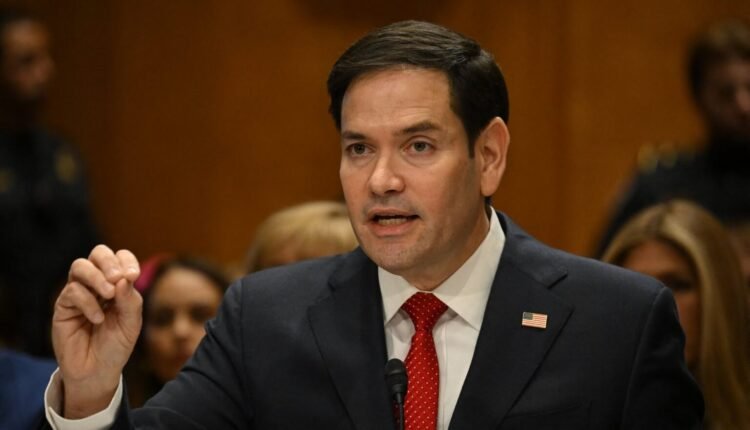
This is one of the most lengthy statements and briefings that US Secretary of State Marco Rubio has issued on Sudan since his appointment by President Trump on 21 January 2025. On Friday, 19 December 2025, the Secretary held a press conference in the United States, producing a transcript running to 61 pages. Of these, 5.8 pages dealt directly with Sudan and peace efforts—roughly 10 per cent of the entire press conference.
A few months earlier, when Congress questioned him during his confirmation process after Trump nominated him in November 2024, Rubio could barely utter a single coherent sentence on Sudan or comment properly on the role of the United Arab Emirates in the Sudan war, despite intense pressure from lawmakers and the Senate Foreign Relations Committee.
But at this press conference, he was remarkably eager to answer questions about Sudan—naturally framed within the broader achievements and strategic objectives the administration has set for its foreign policy.
Foreign Actors and the Failure to Adhere to Commitments
Rubio argued that despite the numerous domestic challenges the administration faces in pursuing the “Make America Great Again” agenda (MAGA), the Trump administration remains engaged in world affairs, including conflicts that may not appear central to the daily lives of average Americans, such as the crisis in Sudan.
He stressed that the President has made peace-building a priority, setting the broad policy frameworks guiding US intervention “whether in the Russia–Ukraine conflict, or between India and Pakistan, or Thailand and Cambodia—an ongoing challenge—or the tragedy we are now witnessing in Sudan, or the potential escalation and collapse in South Sudan, or Armenia and Azerbaijan”.
Rubio emphasised that the US always seeks, as far as possible, to play a mediating role that avoids war or helps end conflict. In many cases, he said, it is possible to bring conflicting parties to the negotiating table and reach an agreement—after which comes the implementation stage. He claimed that progress had been made in several such crises, especially in persuading parties to accept certain terms.
He added that efforts are underway to ensure compliance with these conditions. Many of these conflicts, he noted, have deeply rooted causes. “But we are prepared to engage and offer assistance in ways that other countries may not be able to. We have been seen as indispensable in this respect, and the President takes pride in that role—advancing peace worldwide. It is something for which he deserves much credit. He is personally involved in all of this.”
Rubio was then asked about the war in Sudan—which he described as a “civil war”, though one with strong regional dimensions—and about the US position. What, the journalist asked, is the American red line? Would the partition of Sudan constitute a red line for the US?
Rubio responded by saying it was indeed accurate to highlight the presence of regional actors:
“Clearly, both sides—the Sudanese Armed Forces and the Rapid Support Forces—have external supporters, and we are engaging with those countries. It’s not only the states supplying them with weapons and equipment; it also includes countries facilitating the trans-shipment of arms, particularly to the Rapid Support Forces, including advanced weaponry.”
He stated this quite openly.
Rubio added that the immediate US objective—reiterated to all partners, including during his contacts with leaders in the UAE and Saudi Arabia—was well understood by both sides.
Humanitarian Ceasefire, Not Political Issues, Is Washington’s Current Priority
Rubio explained:
“Our Special Envoy, Massad Paulos, has just returned from the region, where he met Egyptians, Saudis, Emiratis, and others. We have also worked with the UK on some of these matters. Our immediate goal is a ceasefire—a humanitarian truce at the start of the new year that would allow humanitarian organisations to deliver aid to those severely affected.”
He confirmed, however, that such a truce is not currently feasible:
“People continue to hear and see reports of humanitarian convoys being targeted en route. Astonishingly, parts of the convoys are hit while the rest continue. This shows how committed these groups are.”
A Strong Warning from Rubio
“But what we have told everyone is that what is happening there is horrific—terrible. The truth will come out one day, and every party involved will be shown in a very negative light. We have played a key role in bringing the parties to the table. So I think we will know more very soon.”
Rubio complained that one of the greatest frustrations in Sudan is that one side agrees to commitments but does not follow through:
“They agree to anything and implement nothing. And often, when one side feels it is making gains on the battlefield, it sees no reason to compromise—it believes a ceasefire will only cause it to lose momentum.”
He stressed that Washington is fully aware that none of the Sudanese parties could function without external support. Thus, the US is engaging those foreign states to ensure that they are pushing for the same outcome: a humanitarian truce to enable at least some response to the catastrophic situation.
He hinted at a multi-track process, in which, during a ceasefire, attention could shift to addressing the structural causes of the conflict.
But for now, he stressed, “99 per cent of our focus is on achieving this humanitarian truce as quickly as possible. We believe the new year and upcoming holidays offer a great opportunity for both sides to reach an agreement. We are doing our utmost.”
Peace as a Process — and the Role of Paulos in Sudan’s Peace Efforts
Rubio explained that one can reach a peace agreement “in principle”, but then experts must sit down and work through the technical details:
“Any new administration experiences a learning phase. Staff are still being appointed; many positions may still be vacant or awaiting Senate confirmation.”
Yet, he said, he was proud of the coordination achieved over the past year, which continues to strengthen.
He also praised Massad Paulos, who works daily with the Africa Bureau and other agencies on Sudan, Rwanda, and the Democratic Republic of Congo:
“We have an excellent team working in harmony, and we will continue to build on that in the new year.”
The UAE’s Role in Fuelling the War
Rubio acknowledged that a third party is always involved in shipping weapons to the warring sides:
He was specifically asked about earlier comments he made about the transhipment of arms into Sudan—whether he had raised the issue with the UAE and whether he received any assurances that Abu Dhabi would stop supporting the Rapid Support Forces.
Rubio replied:
“Most of these weapons are not manufactured by either side. All of them are purchased from outside. They must be coming from somewhere and passing through somewhere.”
He said:
“Someone must be allowing their entry; someone must be shipping them. Therefore, we have held appropriate discussions with all parties involved in this conflict, because this is the source of their strength. Without external support, neither side can continue. That is why we must engage these states.”
However, as expected from a party that sees itself as a mediator, Rubio avoided naming specific states publicly:
“I don’t want to stand here and single anyone out, except to say we believe and hope we can make progress. But we understand that this progress requires external actors to use their influence and pressure—particularly to secure the humanitarian truce, which is our first objective.”
He added:
“External actors have influence over parties on the ground. We have spoken with the UAE, Saudi Arabia, and Egypt. This is not new—we signed a document with them at the United Nations in September. We held earlier meetings as well. This is ongoing cooperation that has gained urgency due to recent developments.”
Rubio stressed that the US is engaged daily in pursuing a resolution:
“This is not new to this conflict. It is similar to what happened in Gaza. One reason Hamas came to the negotiating table was that states with links to Hamas—such as Qatar and Turkey—played a constructive role in urging and pressuring it to accept an agreement. We played a similar role from our side.”
Thus, he said, it is unsurprising that external actors are involved in pressing the Sudanese parties to negotiate and reach a settlement.
Shortlink: https://sudanhorizon.com/?p=9731