

A Leading American Journal Warns of the Partition of Sudan and Outlines Grim Scenarios if It Occurs (2–2)
Sudanhorizon – Mohamed Osman Adam
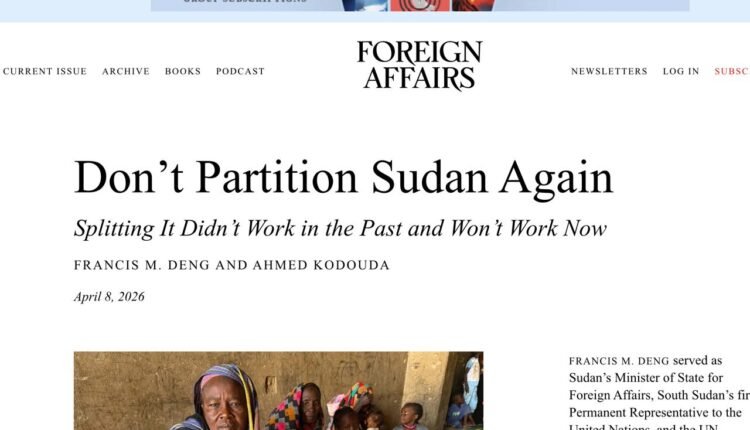
The prestigious American journal Foreign Affairs has published an extensive research paper authored by two prominent academic and political figures from Sudan and South Sudan, Francis Deng and Ahmed Kodouda. In it, they warn Sudanese people against the dangers of another partition of Sudan. For readers’ benefit, Sudan Horizon has summarised and presented the key points of the paper.
Was the Fighting Primarily About Control of Land?
The paper asks—and answers—that, at its core, violence in Sudan has never truly been about territorial control. Rather, Sudan’s entrenched conflicts are the result of the systematic mismanagement of governance by successive regimes in Khartoum, which have extracted resources from and marginalised ethnic groups in peripheral regions.
The Rapid Support Forces, in particular, have relied on a patronage model, supplying weapons to allied Arab communities in exchange for participation in their war effort. However, the loyalty of these groups to the RSF’s command structures is, at best, transactional. Many have used the dominant war narrative as a cover to advance their own political and economic agendas.
Meanwhile, the camp of the Sudanese Armed Forces is itself fragmented. Its alliance—comprising Islamist factions, Darfur rebel groups aligned with the army, and tribal militias—has been held together primarily by a shared opposition to the RSF, rather than by a common vision for a national future.
The authors argue that drawing a dividing line across Kordofan would create two weak states, each suffering from internal divisions, hostile populations, and a lack of economic resources for recovery. Both would have strong incentives to destabilise the other, paving the way for endless fragmented local conflicts and eliminating any remaining chance—however slim—of a negotiated national settlement.
The Impact of Sudan’s Partition on Neighbouring States
The authors further contend that a renewed partition of Sudan would destabilise its neighbours.
Chad faces the most immediate and serious risk. Its ethnic fault lines mirror those of Sudan, and many groups in Darfur—including the Zaghawa, the support base of Chadian President Mahamat Déby—span both sides of the border. If the RSF were to control western Sudan formally, it would provide marginalised Arab communities in Chad with a powerful patron and a source of arms, potentially inspiring similar separatist or autonomy movements. A recognised western Sudanese state could openly receive foreign investment and weapons shipments, and claim legitimacy for cross-border interventions.
Ethiopia faces different but equally serious pressures. The war in Sudan has exacerbated its internal tensions. Ethiopia maintains close relations with the RSF, partly due to shared backing from the United Arab Emirates. However, Ethiopia itself remains fragile: the 2022 agreement that ended the war in Tigray has not been fully implemented, and tensions persist in Amhara and Oromia.
The Sudan People’s Liberation Movement-North—allied with the RSF—controls areas along the Ethiopian border and has recently opened a new front, launching attacks from camps inside Ethiopia into Sudan. RSF control of the Blue Nile would create an isolated enclave, further complicating the situation in the event of partition. A formal division of Sudan could lead to multiple armed entities competing for influence along Ethiopia’s porous borders.
It would also increase the likelihood of renewed direct conflict between Eritrea and Ethiopia. Eritrea has supported the Sudanese army out of concern that the RSF could threaten the regional order and act as a tool of Emirati influence in the Horn of Africa. An RSF-led state aligned with Ethiopia near Eritrean territory would present Asmara with a hostile southern neighbour, destabilising the fragile political balance established since Eritrea’s independence in 1993.
South Sudan would be particularly vulnerable. Its economy depends almost entirely on oil transported through pipelines that cross areas under the control of both the RSF and the Sudanese army. Disruptions caused by Sudan’s civil war have already cost Juba more than half its revenue. Partition would create two states with which South Sudan would need to negotiate, each likely to demand separate transit fees or use pipeline access as political leverage.
In the event of renewed conflict between the two Sudanese states, both would have incentives to recruit proxies within South Sudan. Already weak and divided, South Sudan would struggle to withstand economic coercion, arms flows, and territorial encroachments, further destabilising the country.
The formalisation of an RSF-run state would also entrench illicit gold-smuggling networks operating through the Central African Republic, Chad, and Libya, benefiting armed actors. Conversely, a state governed by the Sudanese army—aligned with Islamist movements—could encourage violent extremism.
What Is the Solution?
The paper concludes that Sudan’s civil war cannot be ended through a narrow focus on the two principal warring factions, nor by attempting to divide power between them or partition the country. Partition would merely postpone the difficult task of building inclusive governance and would create two weak states facing the same internal divisions that currently make governance so difficult.
Genuine peace can only be achieved by comprehensively addressing the root causes of the conflict. Previous peace negotiations failed in part because they excluded Sudanese civilians and focused primarily on security arrangements rather than political transformation.
The most effective strategy, the authors argue, is to:
Address urgent humanitarian needs,
Establish an inclusive political process involving all stakeholders,
Undertake culturally sensitive national reconciliation,
Hold all parties accountable for serious crimes.
Regional and international actors—particularly key regional powers such as Egypt, Ethiopia, Saudi Arabia, and the UAE—should impose an arms embargo, sanction spoilers on both sides, fund civilian-led peace initiatives in areas where fighting has ceased, and make clear that neither faction will receive international recognition without a genuine commitment to protecting civilians. Future engagement should be conditional on meaningful civilian participation.
Final Warning
The report reaches a stark conclusion: current dynamics on the ground are pushing inexorably towards formal fragmentation. However, Sudan’s neighbours and global actors must heed the lesson of South Sudan, where secession did not resolve conflict but instead deepened it.
Any further partition, the authors warn, would come at a very high cost.
Shortlink: https://sudanhorizon.com/?p=12728