

Egyptian and Sudanese Experts:Resolving the Militia Situation in Accordance with Jeddah Declaration
Cairo –Sudanhorizon– Sabah Moussa
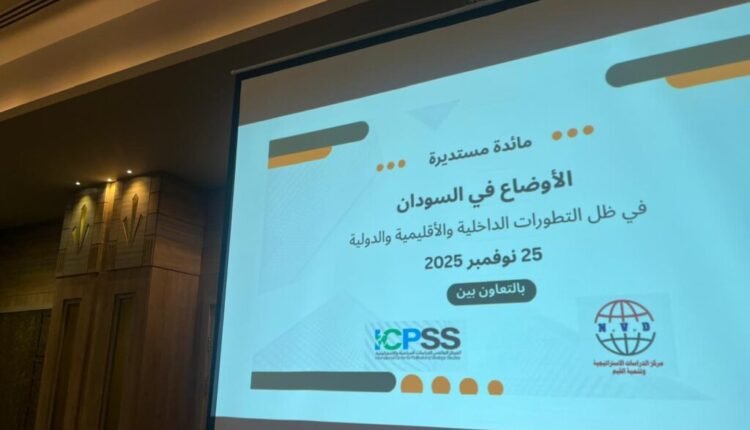
The Egyptian Center for Strategic Studies and Values Development and the Sudanese Global Center for Political and Strategic Studies, jointly held a round table discussion in Cairo, Wednesday, entitled “The Situation in Sudan in Light of Internal, Regional, and International Developments.”
The event was attended by a select group of senior diplomats, experts, researchers, and media figures from both countries.
The opening session was chaired by Major General Khaled Mokhtar, Director of the Center for Strategic Studies and Values Development. Former Sudanese Foreign Minister Dr. Ali Youssef Al-Sharif delivered the keynote address, emphasizing the need for a comprehensive approach to resolving the Sudanese crisis based on internal dialogue and the protection of the country’s unity, sovereignty, and territorial integrity.
Dr. Abdel Aziz Ashar, Director of the Global Center for Political and Strategic Studies, presented an analytical overview of the humanitarian, political, and security developments in Sudan.
The participants discussed the humanitarian situation in Darfur and Sudan in general, the impact of regional and international actions on the course of the conflict, Egypt’s historical role in supporting Sudan and preserving its unity and stability, the future of the Sudanese Armed Forces, the challenges posed by the Rapid Support Forces militia, the management of humanitarian aid, and reconstruction efforts.
The round-table concluded with a set of key recommendations, including reaffirming the territorial integrity of Sudan and preserving state institutions, particularly the armed forces; emphasizing a comprehensive political solution driven by the will of the Sudanese people, guaranteeing the participation of all national parties without exclusion, preserving the unity of the state and the continuity of its institutions, non-interference in internal affairs, and reviving the Jeddah platform and resuming the indirect negotiations it initiated to end the war, which has been condemned regionally and internationally.
The round-table also emphasized the need to resolve the status of the Rapid Support Forces (RSF) according to a clear timetable for integrating or demobilizing its elements, in accordance with the Jeddah Declaration.
It stressed the urgency of delivering humanitarian aid to Darfur, Kordofan, and other affected areas, and the importance of coordinating efforts with Egyptian, Sudanese, and international organizations. Furthermore, the round-table recommended supporting community reconciliation initiatives and involving traditional leaders and civil society in de-escalation processes and achieving justice and equity.
Regarding Egypt’s role, the round-table emphasized its centrality in supporting Sudan’s unity and stability through diplomatic, security, and humanitarian channels. It stressed the importance of continued Egyptian-Sudanese coordination through joint platforms to monitor the progress of mediation efforts with international support. The round-table also highlighted the need to strengthen ongoing communication with Sudanese civilian and military forces to bridge gaps and build trust.
It underscored the necessity of international media outreach to accurately reflect the situation, as well as the importance of closely monitoring global media coverage of the situation in Sudan.
Furthermore, it emphasized the need to produce media materials and awareness videos about the humanitarian situation in Darfur and affected areas, to launch a regular monitoring center to track Sudanese affairs and analyze the positions of regional actors, to collaborate with Arab and international research centers to issue joint reports on mechanisms for resolution and stability, to provide future visions of the conflict and anticipated scenarios, and to enhance the role of civil society organizations in providing relief, combating hunger and poverty, and developing coordination with organizations such as Misr El Kheir, the Egyptian Red Crescent, the Sawiris Foundation, and the Egyptian Food Bank for Social Development to support humanitarian activities.
The participants also emphasized the importance of macroeconomic stability and stressed that reconstruction in Sudan is a prerequisite for political and economic stability.
They called for the involvement of Egyptian and Arab contracting companies in infrastructure reconstruction plans, particularly in the states of Darfur, Gezira, Khartoum, and Kordofan. They also called for the development of a package of engineering and housing projects tailored to the needs of local communities, the activation of partnerships between the private sector and international institutions to support reconstruction, and support for initiatives led by contracting companies sponsoring infrastructure projects.
In conclusion, the round table recommended emphasizing the unity, sovereignty, and territorial integrity of Sudan in any negotiations, linking any international initiatives to a “purely Sudanese vision agreed upon by civilian and military leaders,” and called for raising security awareness regarding the spread of Israeli activity in the region and its future objectives. It also called for support for efforts to achieve justice, transitional justice, and accountability for violations.
The participants unequivocally condemned the terrorist crimes, killings, widespread violations, looting, and theft perpetrated by the Rapid Support Forces militia against the Sudanese people. They demanded that all those involved in these crimes be referred to the competent international courts, considering them war crimes that necessitate immediate accountability and a comprehensive investigation without any delay.
They called upon all Sudanese national forces, parties, and political and social components to agree on a unified national vision aimed at protecting the Sudanese state, preserving the nation’s integrity and territorial unity, and rejecting any disputes or divisions that could harm the internal situation or weaken the national front in the face of the serious challenges the country is experiencing today.
The round-table stressed the need for international and regional powers to take these recommendations into consideration and adopt them as practical steps that contribute to resolving the ongoing conflict in Sudan in order to preserve its unity and territorial integrity.
Shortlink: https://sudanhorizon.com/?p=9067