

University of Khartoum: In the Wrong or Wronged?
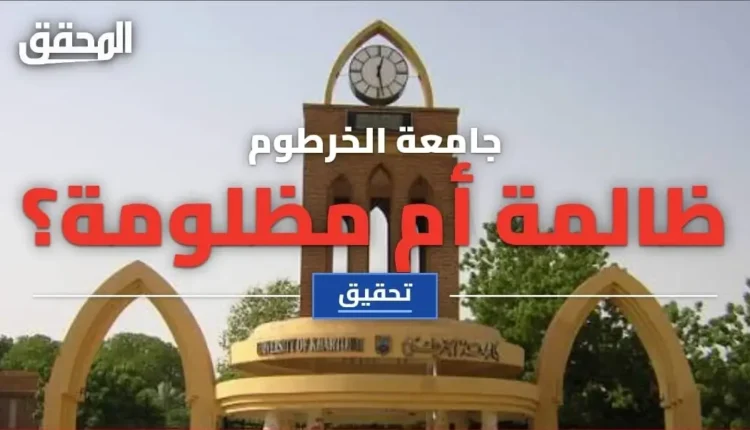
Sudanhorizon – Nashwa Ahmed Al-Tayeb
In the space of one week in September 2026, the University of Khartoum issued two official documents addressing the same matter. The first was minutes dated 11 September 2026 and signed by the university’s Deputy Vice-Chancellor, the Dean of the Faculty of Medicine, the Chair of the Professors’ Committee and its rapporteur. It stated that the university was committed to securing the financial entitlements of professors who had reached retirement age and whose contracts were to be renewed for another year. The second document contained the outcomes of a meeting of the university’s Deans’ Council, issued on 15 September 2026, just four days later. It stated that contract renewals must not impose any financial burdens or obligations on the university.
The University of Khartoum occupies a place in Sudanese memory that extends far beyond its status as an educational institution. It is one of the country’s oldest academic institutions. Over the decades, it has produced scholars, intellectuals, doctors and opinion leaders whose names have become prominent in academic and professional circles in Sudan and abroad. Its Faculty of Medicine is among its oldest colleges and has a particularly prominent place in this history. What is unfolding there today, therefore, goes beyond a limited administrative dispute. It raises questions about the future of an institution closely associated with the history of higher education in Sudan.
Between these two documents stands a faculty that says it has never suspended its work throughout the war and has graduated three batches of doctors. Its professors say that most of them are no longer in their positions, that the Faculty Council, without whose approval no results can be ratified, is no longer fully constituted, and that a graduating class is waiting to sit its examinations and complete its studies. They also say that their salaries have been paid inconsistently or not paid at all. On the other side is a university whose response has yet to be received, and which has its own documents, decisions and the constraints of operating during wartime.
Sudanhorizon Obtains Official Documents and Hears from Faculty of Medicine Professors
This investigation presents the events as recorded in official documents obtained by Sudanhorizon from sources within the university, alongside accounts provided by professors who spoke to the publication. Sudanhorizon sought statements from the university’s Vice-Chancellor and the Minister of Higher Education and Scientific Research but had received no response from either by the time this investigation was published on 5 November 2026.
A Faculty That Did Not Stop During the War
One statement recurs in the accounts of all the professors: the faculty never stopped working. Teaching and examinations continued throughout the years of war in Sudan, and three batches graduated. Dr Sarah Misbah Al-Sadiq, Chair of the Faculty Professors’ Committee and former Head of the Department of Internal Medicine, estimates that between 650 and 700 students have graduated.
This was also acknowledged by the university’s own administration. The minutes of a meeting held on 10 September 2026 begin by recording that the Vice-Chancellor welcomed those present and commended the faculty’s professors for maintaining the academic process throughout the years of war, an effort that had resulted in the satisfactory graduation of three batches.
Between Meeting Minutes and Council Decisions: Who Will Bear the Cost of Retaining Faculty of Medicine Professors?
In her account to Sudanhorizon, Dr Hajar Al-Rashid Saad, Assistant Professor, former Head of the Department of Pathology and former Director of Laboratories at Soba University Hospital, explains how the faculty operates under normal circumstances. As she describes it, the faculty functions through councils, departments and committees, while the academic calendar remains fixed unless external circumstances require a change.
The Faculty Council is the body responsible for approving examination results. It comprises senior professors, department heads and their representatives, the dean and two deputies, the registrar, as well as representatives of relevant institutions, including directors of university hospitals, the Sudan Medical Council, the Medical Specialization Board and the Ministry of Health.
She says results do not become final until they have passed through the relevant departments and the Board of Examiners and have been approved by the Faculty Council.
Who Are the Monthly-Contract Professors?
At the heart of the dispute is a group known in Sudanese universities as professors on monthly contracts. These are professors retained under monthly contracts after reaching the statutory retirement age.
Dr Sarah estimates that they account for approximately two-thirds of the Faculty of Medicine’s academic staff and describes them as the faculty’s institutional memory. According to her, they are responsible for scientific research and the Research Ethics Committee, select external examiners, and approve examinations and results, as they constitute the majority of the Faculty Council.
The University and Ministry Have Not Responded to Sudanhorizon Despite Repeated Attempts
Dr Hajar says this has direct consequences. If the contracts of these professors are not renewed, they cease to be members of the teaching staff and can no longer attend council meetings or approve results. This, she argues, brings the faculty’s decision-making process itself to a halt. She says this is what prompted the professors to convene.
How the Dispute Began
According to Dr Sarah, the dispute began in June 2026, when the Vice-Chancellor refused to renew the monthly-contract professors’ agreements.
Dr Hajar recounts a more specific sequence of events. At the time, she was heading her department and had travelled to Sudan for a short visit to take her mother to a medical appointment. During the visit, she attended a meeting with department heads and the dean. The administration had asked department heads to identify professors who had reached retirement age and collect their documents so their contracts could be renewed automatically. They completed the task.
The Vice-Chancellor then called an emergency meeting and requested a new list distinguishing between professors inside Sudan and those abroad. Dr Hajar says those present expressed reservations and concern, but the Vice-Chancellor immediately reassured them that everyone’s contracts would be renewed and that the exercise was merely a census.
She adds that two or three days after returning from her trip, she was surprised by a decision from the Deans’ Council stipulating that professors had to be physically present in Khartoum for their contracts to be renewed.
August 2026: The Attendance Requirement and the Salary Register
Dr Hajar identifies the August 2026 salary payment as a turning point. She says the Deans’ Council decided, in accordance with what she describes as Ministry of Higher Education directives, that all professors had to be physically present during the month. She says the decision did not take into account the circumstances of university accommodation or professors’ existing overseas employment contracts, which required notice periods before they could leave.
When asked how the administration intended to establish who was physically present, the Deputy Vice-Chancellor reportedly suggested that professors sign the salary register as proof of attendance.
Dr Hajar says professors heard from people close to the Vice-Chancellor, in audio recordings, that failure to sign would be treated as a full month’s absence and could lead to disciplinary proceedings and eventual dismissal if the absence was not justified. She concludes that August salaries were withheld on this basis.
Dr Hajar also offers an explanation for what happened subsequently with salary payments, including those of professors she says had been denied payment because their contracts were not renewed and they were not in Khartoum.
In her view, the faculty’s results, including those for the sixth year, can only be approved by a Faculty Council with a full quorum. Without that quorum, results remain pending and students cannot graduate. She argues that the administration therefore needed to retain the professors until they approved the results, after which, she believes, it intended to dispense with them.
This is Dr Hajar’s personal assessment of the administration’s motives. Sudanhorizon sought the administration’s response to this allegation but had not received one by publication.
Professors’ Meetings and the Mandate Given to the Elders’ Committee
According to a briefing issued by the professors, their first meeting was held on 22 August 2026, after the monthly contracts had expired, salaries had been linked to physical attendance and a short deadline had been set for professors to return. At the time, they estimated that the faculty could lose more than 90 per cent of its academic staff.
They stressed that they were not opposed to returning to Sudan, but wanted the process to be gradual and carefully planned, while retaining the monthly-contract professors and ensuring that education continued through appropriate means. They also insisted that examinations should not be held unless all academic and staffing requirements were in place.
Their second meeting took place in late August 2026 after memoranda and dialogue had failed to produce results. The options of collective resignations and institutional escalation were raised, while participants stressed that their shared objective was to protect the faculty, not disrupt its work.
On 2 September 2026, they decided to give dialogue another chance. They appointed a committee of senior faculty professors, chaired by Professor Mohamed Ahmed Ali Al-Sheikh, the university’s former Vice-Chancellor, to meet the administration and return with written outcomes. They also made proceeding with the examinations contingent on resolving staffing issues and ensuring that the departments were ready.
Dr Hajar, who was a member of one of the professors’ committees, recounts that a high-level delegation met the Vice-Chancellor after he issued his decision not to renew the contracts. She says he delayed responding and travelled outside Sudan, meeting the delegation a week after his return. The committee submitted a memorandum supporting a return to work on the condition that it be phased over one year. His response, she says, was that changing the decision was “impossible”. The committee subsequently received a written reply that, according to her, did not address the points discussed.
Students Caught Between the Examination Schedule and a Strike
Meanwhile, students were facing their own predicament. On 27 August 2026, an examination timetable was issued for the sixth-year students of Batch 96. These are the final examinations preceding graduation.
In a statement dated 8 September 2026, the Faculty of Medicine Students’ Association said the batch’s family council had asked department heads whether the examinations could be held as scheduled. Three of the four responded that they could not.
The students then contacted the faculty administration to ask whether it was ready, but received no response. They subsequently asked the dean to postpone the examinations, arguing that holding them exclusively in Khartoum would impose considerable financial and logistical burdens on approximately half the batch, who were living in other states or outside Sudan.
Executive Director of the “Ardeib” Office Welcomed the Press, Then Stopped Responding After Receiving the Publication’s Questions
The students described themselves as caught between an announced examination timetable and the possibility of a professors’ strike. Their statement said that passive waiting, with only 12 days remaining before the first examination session, would constitute a clear violation of their rights and undermine their stability.
The statement received by Sudanhorizon ends with this passage, without a conclusion or signature.
The Meeting of 10 September 2026
On the evening of Thursday, 10 September 2026, an online meeting brought together University of Khartoum Vice-Chancellor Professor Imad Eddin Al-Amin Al-Taher Ardeib, Deputy Vice-Chancellor Dr Mahmoud Ali Ahmed Mohamed, Faculty of Medicine Dean Professor Abdulsami Abdullah Mohamed, and the Professors’ Committee, chaired by Professor Mohamed Ahmed Ali Al-Sheikh.
The Deputy Vice-Chancellor, the dean and the committee’s rapporteur, Professor Ammar Al-Taher Mohamed, prepared the minutes of the meeting. The document was dated the following day, 11 September 2026, and signed by the committee chair and rapporteur, the Deputy Vice-Chancellor and the dean. It does not bear the Vice-Chancellor’s own signature.
The minutes stated that monthly-contract professors would continue performing their duties and would electronically accept a one-year offer, while the university administration would undertake to secure their financial entitlements upon completion of their contractual procedures.
They also stipulated that monthly-contract professors and those below retirement age would continue receiving their salaries while performing their duties throughout the 2025-2026 academic year. Professors below retirement age who remained in service were to regularise their employment status after the academic year, in a manner consistent with labour and civil service laws.
The meeting agreed that sixth-year examinations would be held inside Sudan. The faculty administration and department heads were to determine an appropriate postponement period that would allow students abroad to join the next examination cycle, while preserving the opportunity to sit the examinations for those unable to attend.
In a final item, the committee requested that examinations also be held in Riyadh and Cairo to ease the burden on families and the small number of professors in the capital. The Vice-Chancellor declined, saying this was a state decision applying to all external examination centres.
The professors accepted these outcomes, despite falling short of all their demands, according to their briefing. The documents do not specify which requests were not granted.
Two Documents in One Week…
Four days after the meeting minutes were dated, the university’s Deans’ Council issued the outcomes of its meeting on 15 September 2026.
The document stated that teaching staff below the monthly-contract category had to clarify their positions, either by returning to Sudan and resuming work or by submitting an apology in accordance with the regulations.
The council decided to renew the monthly contracts of all professors outside Sudan for one year, provided that this did not impose any financial burdens or obligations on the university. Their employment status would be regularised upon their return.
It also confirmed that there would be no online teaching and that teaching responsibilities would be distributed among professors physically present in Sudan. The document did not explain the reasons underlying these decisions.
90% of the Academic Staff on the Verge of Leaving
The difference between the two documents is clear. The meeting minutes refer to the university’s commitment to securing financial entitlements and allow until the end of the academic year, while the Deans’ Council outcomes stipulate that renewals must not create financial obligations and require professors to clarify their positions immediately.
The phrase “without financial burdens” may have an interpretation that reconciles the two documents, such as financing the entitlements through a source other than the university’s budget. However, the documents do not say this.
Dr Hajar’s account provides another possible clue. She says that immediately after the examination timetable was announced, the Human Resources Department issued electronic contract-renewal forms requiring professors to wait until they returned to Sudan to complete the procedures, while absolving the university of any financial obligations before their return.
If this is the case, the point of disagreement may lie in the phrase “upon completion of their contractual procedures” in the meeting minutes. Are the entitlements to be paid before the procedures are completed, or only afterwards?
After the Agreement: The Professors’ Account
On 28 September, the Faculty of Medicine professors issued a statement saying they had accepted the Elders’ Committee’s outcomes despite these falling short of their demands. They said they had fulfilled their commitments by continuing teaching and preparing for examinations, while the administration had failed to implement the core elements of the agreement.
According to the statement, the monthly contracts had not been renewed for a year with the corresponding entitlements, as agreed. Salaries for professors below retirement age who were living outside Khartoum or outside Sudan had also remained unpaid, despite their continuing to perform their duties.
The professors warned that this situation could lead to the university losing approximately 90 per cent of its academic staff. They described the reversal of agreements and the succession of contradictory decisions as institutional instability that undermined confidence in the administration.
They called for implementation of the agreement, renewal of monthly contracts with the corresponding financial entitlements for one year, payment of the entitlements due to professors below retirement age, and an end to contradictory decisions. They also confirmed that they would proceed with examinations at all academic levels, stressing that doing so did not mean relinquishing their rights.
Dr Sarah says the agreement was not implemented and that the contracts the Vice-Chancellor had said would be renewed were not renewed. She describes salary payments in the following weeks as inconsistent, varying from one professor to another, without the professors knowing why. She does not directly accuse anyone of financial misconduct but says an explanation is needed.
Dr Hajar says the August 2026 salary was paid alongside the September salary in what she describes as an arbitrary manner. Some professors received only part of their salaries, while others received varying amounts. She has called for transparency and a review of the university’s budget and its reconstruction budget during the war years.
At a meeting on 7 October 2026, a briefing stated that September salaries had been paid to some professors, with varying amounts across categories and grades, while others had received nothing. It also said that August salaries had not been paid to the affected categories.
The author of the briefing noted that the timing of these payments suggested they were a response to pressure surrounding the sixth-year examinations. Dr Hajar says the agreement was breached as soon as the examinations were announced, but that the professors nevertheless decided to proceed with them to protect the students’ futures.
Online Education and External Centres
The issue of online education and external centres is among the main areas of disagreement between the two professors and the administration.
The Deans’ Council outcomes dated 15 September explicitly stated that there would be no online teaching.
Dr Sarah says the Ministry of Higher Education had approved a proportion of distance learning of up to 30 per cent, taking into account the circumstances of students and professors scattered across different locations. She says the Vice-Chancellor preferred in-person teaching.
Dr Hajar says the ministry has regulations permitting online and blended learning, and that the faculty had organised a training workshop on digital platforms. She says the Vice-Chancellor rejected online education verbally but did not issue a written decision to that effect.
Sudanhorizon did not receive a statement from the Ministry of Higher Education concerning the regulations or the decision. The claim that no written decision was issued appears inconsistent with the written Deans’ Council outcomes. It is possible that Dr Hajar was referring to a subsequent meeting.
As for external centres, Dr Hajar says they had operated in Saudi Arabia, Atbara and Cairo for clinical training, with students bearing the costs rather than the university.
During the 10 September meeting, the Vice-Chancellor attributed his refusal to hold examinations in Riyadh and Cairo to a state decision concerning all external centres.
Dr Sarah had acknowledged that closing the centres was a state policy, but argued that the administration could have made greater efforts to keep them operating and allow professors abroad to teach their students alongside those inside Sudan.
On 26 October 2026, more than six weeks after that meeting, the Council of Ministers’ media office announced that Prime Minister Professor Kamil Idris had directed the Ministry of Higher Education and Scientific Research to allow higher education centres outside Sudan to continue operating until their status was regularised in accordance with approved regulations and requirements.
The directive does not mention the University of Khartoum or its Faculty of Medicine by name. Nor does it clarify whether it covers the university’s training and examination centres in Saudi Arabia and Egypt, or specify the regulations and requirements to which it refers.
Nevertheless, it came after the Vice-Chancellor had presented the matter as a state decision and was issued by the country’s highest executive authority. It calls for the continuation of this type of centre rather than its closure.
Sudanhorizon did not receive a statement from the ministry or the university explaining whether the directive applies to the university’s centres or whether the administration has reconsidered its position in light of it.
Criticism of Administration and Governance
In their accounts to Sudanhorizon, the two professors go beyond the implementation of the agreement to question the university’s management.
Dr Sarah says the university is being run through unilateral decisions. She claims that although the Vice-Chancellor has a Deans’ Council, there is, to her knowledge, no supporting University Council. She also says his term of office expired in March 2026, that the Ministry of Higher Education is aware of this and has been seeking a replacement without finding one.
Dr Hajar relays accounts from people who attended Deans’ Council meetings, saying the Vice-Chancellor speaks and makes decisions alone, while decisions are issued in the council’s name. She also says the new deans have limited experience after replacing those who were outside Sudan.
Sudanhorizon sought the administration’s and ministry’s responses to these claims.
Dr Hajar says professors who opposed the Vice-Chancellor, including herself, Dr Sarah and Dr Hala Zaki, were relieved of their department head positions because they were outside Sudan. She says the decisions were made by the Vice-Chancellor without consulting the department heads, their departmental councils or the dean. According to her, they were simply informed that someone else had become head of their department.
Only the administration can clarify the legal basis and dates of these decisions and the regulations under which they were issued.
What the Professors Are Demanding
Dr Sarah summarises their demands as the reinstatement of monthly-contract professors through renewed contracts and payment of their entitlements; restoration of the bodies responsible for supporting academic decision-making at the university and faculty levels; adoption of a teaching model combining in-person and online instruction; and the provision of accommodation for professors returning temporarily, student housing, computers and an online learning platform.
She is also calling for a change in the university’s Vice-Chancellor so that a successor can begin by reviewing the faculty’s structure and governance.
She says the professors see no body capable of guaranteeing the implementation of any agreement. This, she explains, is why they have resorted to media and legal escalation and considered collective resignations. Their letters, she says, have been sent to the Ministry of Higher Education, the Office of the Prime Minister and the Sovereignty Council.
Dr Hajar stresses that the professors have rejected any trade union or political representation, insisting that their dispute is purely professional and aimed at saving the faculty.
She adds that the faculty’s reconstruction has depended less on the university’s efforts than on those of its graduates. She estimates that approximately 95 per cent of the reconstruction of its facilities has been funded through alumni contributions.
The Council of Ministers’ Directive and the Wider Context
In a broader context, Directive No. 108 was issued by the General Secretariat of the Council of Ministers on 17 September 2026. It requires employees of state institutions to report to their workplaces within 45 days, a deadline that would have expired around 1 November if calculated from the date of issuance.
On 22 September 2026, Dr Khalid Abdel Majeed Zamrawi submitted a grievance memorandum through the Minister of Justice on behalf of employees affected by the war. It called for the deadline to be cancelled and for a phased return in three stages to be adopted.
The memorandum does not concern the Faculty of Medicine professors, and the available documents do not establish whether the directive applies to the university.
Sudanhorizon Seeks Responses
Sudanhorizon sought statements from the parties concerned and gave them an opportunity to respond before publication.
The publication contacted University of Khartoum Vice-Chancellor Professor Imad Eddin Al-Amin Al-Taher Ardeib beginning on Saturday, 31 October 2026, but received no response by the time this investigation was published.
It also contacted Dr Ahmed Babiker, Executive Director of the Vice-Chancellor’s Office, beginning on Sunday, 1 November 2026. He initially welcomed the press, describing it as the fourth estate, but stopped communicating after Sudanhorizon sent its questions.
The questions began with the minutes dated 11 September: Did the administration approve the document signed by the Deputy Vice-Chancellor, the dean and the Professors’ Committee? What is its relationship to the Deans’ Council outcomes of 15 September 2026? Which of the two documents is authoritative, given that the minutes refer to the university securing the professors’ entitlements while the council’s outcomes stipulate that no financial obligations should arise for the university?
The publication also asked about the contracts: Were the monthly-contract professors’ agreements renewed for one year? How many contracts were renewed, and how many were not?
Regarding salaries, it asked whether August and September 2026 salaries had been paid to all professors. If some had not received them, what was the reason, when would payment be made, and where was the funding coming from?
It also asked about professors below retirement age who live outside Sudan: Are they required to return immediately, or will they be given until the end of the 2025-2026 academic year? What happens to those who do not return?
On examinations, it asked what the currently approved date was for the sixth-year examinations and how students living outside Khartoum would be able to sit them.
The questions also addressed the dispute itself: Does the Vice-Chancellor expect a large number of faculty professors to leave if the disagreement continues, and how many does he estimate? What solutions does the university propose, and when will they be implemented? Does the university need support from the Ministry of Higher Education or the state, and what has it requested from them?
As for the Ministry of Higher Education and Scientific Research, Sudanhorizon attempted to contact Minister Professor Ahmed Mudawi Musa on Sunday, 1 November 2026, but received no response by publication.
The publication also sought to contact the ministry’s Undersecretary through its media office. The office initially promised to check and respond, but later informed Sudanhorizon that no statement was available by the time of publication.
Sudanhorizon sought to establish the ministry’s position on online teaching, the directives requiring professors to be physically present in August 2026, the funds reportedly allocated to facilitate professors’ return, the status of the Vice-Chancellor’s term and the establishment of a University Council, as well as the dispute itself and possible ways of resolving it.
Other questions remain unanswered pending a response from the administration. These include: Were professors asked to sign the salary register as proof of attendance in August 2026, and what was the purpose of this requirement? What exactly did the electronic forms issued by Human Resources say about contract renewals? Were salary payments linked to the completion of the Faculty Council’s quorum to approve the sixth-year results, and what would happen to these professors’ contracts once the results were approved?
What was the legal basis for relieving department heads of their positions, and when were these decisions made? Is there a functioning University Council? What is the status of the Vice-Chancellor’s term? Does the Prime Minister’s directive of 26 October 2026 allowing higher education centres outside Sudan to continue operating apply to the University of Khartoum’s centres, and what action will the university take in response?
Sudanhorizon reiterates that the door remains open for the Vice-Chancellor, the ministry and everyone named in this investigation to respond. Any statements received will be published in full.
In the Wrong or Wronged?
The documents alone cannot answer the question raised by this headline, and it would be inappropriate to reach a conclusion before hearing from the party that has not yet spoken.
On the professors’ side, there is a document signed by the Deputy Vice-Chancellor and the dean that commits the university to securing their financial entitlements. Four days later, the Deans’ Council issued outcomes that appear to stipulate the opposite. The professors have made serious allegations concerning the reversal of agreements, the university’s management, the removal of department heads and the administration’s motives. The university administration must be given the opportunity to respond to these claims.
The university, meanwhile, is operating under the constraints of a war whose impact cannot be ignored. According to the Vice-Chancellor, the external centres were subject to a state decision, although a subsequent directive from the Prime Minister called for higher education centres outside Sudan to continue operating. Examinations are proceeding, and the Deans’ Council is an official body with authority to make decisions.
The students, regardless of where the truth lies in this dispute, are among those most affected.
What the documents do establish is that the dispute revolves around a specific question: who is responsible for bearing the cost of retaining these professors at the faculty, and which of the two documents is authoritative?
Once that question is answered through a clear written decision and publicly disclosed payment records, it will be easier for readers to judge who has wronged whom.
Shortlink: https://sudanhorizon.com/?p=19880