

When the US Secretary of State Hints that “national interests supersede lofty values,” what can the world expect from the United States?
Sudanhorizon – Mohamed Osman Adam
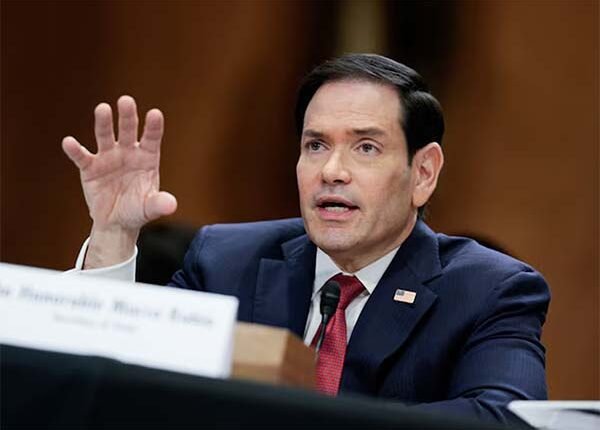
A week has passed since US Secretary of State Marco Rubio made striking and surprising statements regarding Sudan and the principles that will govern his country’s approach to international relations—and, in his own words, ““At least as long President Trump is in office”- as well as its handling of war and peace issues in Sudan.
These realities were hardly a secret, yet no one expected the Secretary to articulate them with such blunt candor; this explains the absence of any strong or tangible reactions. Nevertheless, the statement was forthright and pragmatic, outlining how governments and various entities should engage with his administration if they wish to achieve results—and Sudan is no exception.
– Universal, lofty values and principles no longer exist:
On September 22, 2026, on the sidelines of the current UN General Assembly meetings, Rubio told journalists and media representatives that there are no longer lofty principles or international directives dictating what people should do or avoid in international relations—save for each nation’s national interests, which are, of course, assessed from the perspective of the current US administration. In press statements reposted by the State Department, Rubio said: “Look, the international order is not in good shape right now. And those international norms people talk about… I believe the limits of those norms are defined by your national interest.” He further emphasized that “ultimately—a point the President and I have stressed from the start—this administration’s vision is that any government’s primary obligation is to its own country’s national interest.”
With these remarks, Rubio effectively poured cold water on the lofty principles and charters established by the UN’s founding fathers; while the international community—at the very least—maintains a veneer of diplomacy and polite, figurative language, Rubio did no such thing. His bottom line is this: if you want the United States on your side, you must demonstrate what it stands to gain—or at least what it won’t lose—by getting involved; only then will you secure American support and backing. It is as simple as that.
In his view, this is because the international order—and the United Nations in particular—has outlived its original purpose; it has become entangled in various matters where it ought not to intervene, yet simultaneously proves incapable of resolving almost any major global conflict.
“Therefore, I believe there is a consensus—both at this current UN gathering and more broadly—that the international order is broken, but it is broken due to its own practices; it needs to be steered back onto the right track and toward its proper role.” Rubio went even further in his responses to the media (spanning 53 pages), asserting that it would be ideal to have an effective international system—one capable, for instance, of addressing the war between Thailand and Cambodia, a potential conflict between India and Pakistan, the situations in the Democratic Republic of the Congo and Rwanda, events in Sudan, or tensions involving Iran in maritime straits.
He then made a forceful statement: “At present, we appear to lack an effective international system capable of addressing these issues; in the absence of such a system, nation-states will act according to their own national interests.”
– The U.S. Vision for Peace in Sudan:
To illustrate the importance of the Sudan issue to the U.S. administration at this particular moment, suffice it to say that Rubio devoted almost 5% of his public remarks to the subject—equivalent to two pages out of the 47 published by the State Department website. He highlighted three points: the humanitarian situation in Sudan is both tragic and complex; external interventions in the war are further complicating matters; and he chose not to name the external parties involved in the conflict—”to avoid further complication.” Nevertheless, he believes the Trump administration is currently dedicating significant attention to resolving the Sudan crisis.
– How is this being done?
Secretary Rubio noted that his administration has assigned a team of specialists to work on the Sudan file on a full-time basis. He also expressed deep frustration, noting that while agreements have been reached in various forums around the world… The parties agreed to the terms and signed them, yet those obligations were never fulfilled.
He added: “I want to be frank; we all realize that what is happening in Sudan would not have occurred were it not for foreign actors supporting one side or the other—a situation that is causing growing frustration. We have engaged with this file and participated in it, striving—alongside the United Kingdom and other nations—to play a role in pushing these efforts forward.”
– What is hindering these efforts and preventing the achievement of tangible results?
The US official expressed his frustration, stating: “Every time it seems we are making progress toward a goal—or at least a specific step (while we certainly wish to see a lasting peace agreement, we aspire—at a minimum—to open humanitarian corridors given the magnitude of the humanitarian disaster there)—just as we appear on the verge of progress, one side or the other pulls back, believing they are achieving victory or are capable of doing so.”
There are external parties involved, but even before journalists could ask about them—with most eyes turning toward the UAE—the US official hastened to clarify: “I will not name those parties; you know who they are. I do not wish to create further tension or unnecessary friction. Nevertheless, this war, this conflict, and this crisis would not have happened without the active involvement of external parties fueling one side of the conflict or the other.”
Rubio said his country was raising this issue in every forum and in every setting possible.
He said the US would like to see a positive outcome there. At minimum, it would like to see the humanitarian situation addressed because it’s catastrophic and horrifying. Aid groups cannot go into these active combat zones. Both sides have made commitments to allowing certain areas to be safe, “and then they don’t live up to it.”
He concluded that Sudan issue with the statement that his country “would like to see the war ultimately solved, but that doesn’t mean we’re going to stop – but if we can at least achieve the humanitarian achievement in the short term, we can build upon that, and that’s what we’ve tried to do. But it’s been frustrating, as I said, because of external players that are involved
Shortlink: https://sudanhorizon.com/?p=18497