

UN Human Rights Council Extends Fact-Finding Mission, Sudan Criticizes Ignoring Its Reservations
Geneva – Sudanhorizon
The United Nations Human Rights Council on Monday decided to extend the mandate of the Independent International Fact-Finding Mission for Sudan for one year, amid strong government criticism of the resolution, which was approved by 28 countries, opposed by 10, and supported by 9 abstentions.
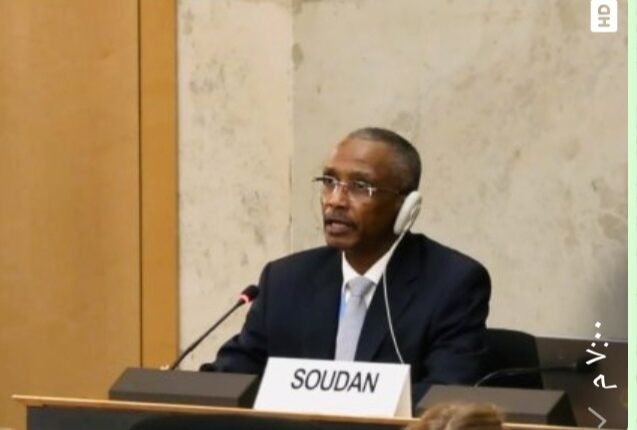
Commenting on the resolution, which was introduced by Britain, Sudan’s Permanent Representative to the UN Office in Geneva, Ambassador Hassan Hamed Hassan, affirmed that Sudan’s valued cooperation with human rights mechanisms demonstrates that the protection of human rights is a top national priority for the state. He pointed to constructive engagement between the government and the country office, the appointed expert on the human rights situation, and the team of experts established pursuant to UN Security Council Resolution 1591, stressing that all three mechanisms enjoy Sudan’s acceptance and full cooperation.
The ambassador outlined the state’s efforts, explaining that following the outbreak of the war, the government promptly established the National Committee of Inquiry into Crimes and Violations of National and International Humanitarian Law under Sovereignty Council Chairman’s Decision No. 143/2023, with the aim of ensuring accountability and preventing impunity. He noted that the committee has so far submitted five interim reports to the Council.
He added that Sudan’s delegation had expressed its readiness to apply the principle of “complementarity,” whereby the role of any external mechanism would complement, rather than replace, the role of the national committee. However, the sponsors of the resolution avoided including an explicit provision guaranteeing this principle and respecting the Sudanese judiciary.
Ambassador Hamed stressed that the sponsors of the resolution had ignored fundamental reservations affecting Sudan’s sovereignty. He also criticized the placing of the Armed Forces, which are carrying out their constitutional duties, on an equal footing with a rebel militia that has committed grave violations, while disregarding the primary role of national judicial institutions.
China had rejected the draft resolution and requested that it be put to a vote, a position supported by Egypt, which also rejected the resolution. The vote resulted in the adoption of the resolution with 28 countries voting in favor, 10 against, and 9 abstaining, meaning that 19 of the Council’s 47 member states did not support the resolution.
Shortlink: https://sudanhorizon.com/?p=18674