

U.S. Official Outlines Washington’s Africa Policy Priorities
Sudanhorizon – Mohamed Othman Adam
A senior official at the United States Department of State, Nick Checker, delivered a speech in Washington, D.C. on March 19, 2026, titled “America First in Africa.” It marks the first time the State Department, under Marco Rubio, has publicly outlined what it describes as the broader Trump administration policy toward Africa.
For the first time, the State Department signaled that the motivations driving the Trump administration are no longer centered on ideals such as ethics, values, and human rights, which had previously dominated discourse. Instead, it is now advancing a more pragmatic policy built on three pillars: commercial diplomacy, restructuring foreign aid, and conflict resolution.
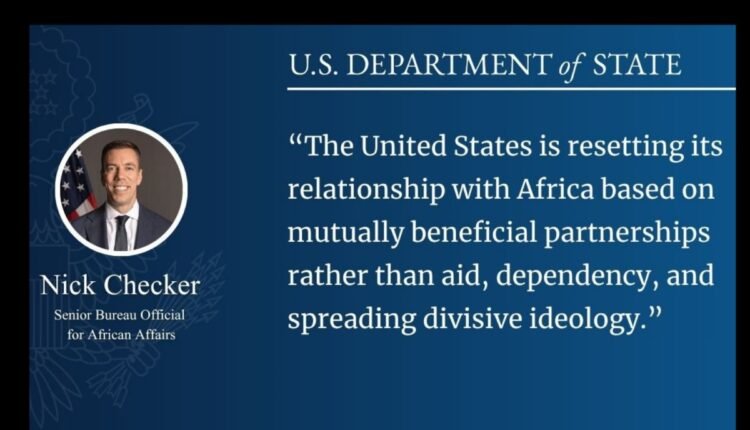
Checker stated that the United States is redefining its relationship with Africa based on “mutually beneficial partnerships, rather than aid, dependency, or the export of divisive ideologies.”
He added: “This reality means we must deal with governments as they are, not as Washington wishes them to be. We have no illusions about the end of history.”
He emphasized that engagement does not equate to endorsement, but rather reflects acceptance of political realities, avoiding attempts to impose internal legitimacy, relying on quiet influence in value-based issues, steering clear of public moralizing, and prioritizing partner countries willing to cooperate on key issues—from curbing destabilizing mass migration to unlocking the power of the American free market.
Based on these principles, the official identified three main areas of U.S. focus in Africa: commercial diplomacy, re-evaluating foreign aid, and conflict resolution and management. He noted that Washington’s goal is to increase U.S. exports and investments in Africa to achieve mutual prosperity, while leveraging Africa’s abundant natural resources and untapped economic potential to secure supply chains.
The official also presented a broader U.S. perspective that Africa represents the next major global commercial opportunity. “Nine of the twenty fastest-growing economies are in Africa, and by 2050, a quarter of the world’s population—2.5 billion consumers with purchasing power exceeding $16 trillion—will live there,” he said. This points to significant U.S. investment opportunities in energy generation, infrastructure, and supply chains.
He acknowledged that Africa currently accounts for only about 1% of U.S. exports, but stressed that ongoing economic and demographic shifts offer substantial room for growth that would benefit both the United States and African countries.
The official further highlighted Africa’s central role in the global race for critical minerals, from cobalt and copper to graphite and rare earth elements. He stated that the Trump administration’s strategy on critical minerals in Africa is based on a clear and ongoing demand from African partner governments for increased U.S. investment in their mining sectors.
He concluded by emphasizing that U.S. foreign aid is no longer viewed as charity, but as strategic capital to be invested wisely in service of American interests, adding that Washington expects its allies and recipient countries to take U.S. strategic and commercial priorities seriously.
Shortlink: https://sudanhorizon.com/?p=12259