

The Consultative Mechanism for Peace in Sudan: Continued Meetings and Distant Results
Cairo – Sudanhorizon – Sabah Moussa
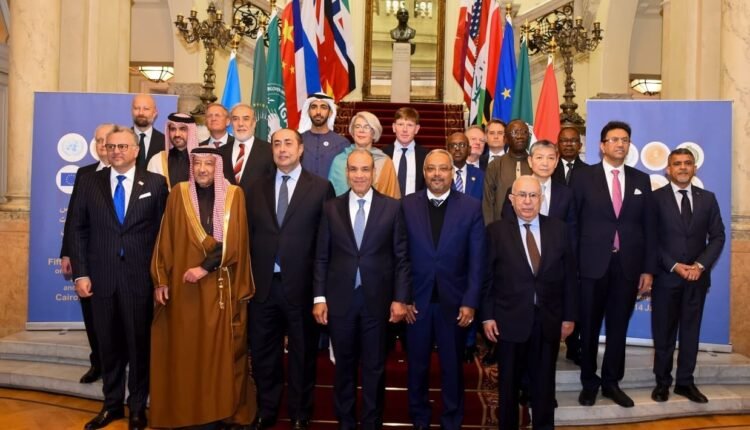
A fifth consultative meeting was held in Cairo between regional and international organizations and interested countries that have have tabled initiatives about peace realization in the Sudan. This meeting represents a continued collective effort to intensify efforts and coordinate peace initiatives in a country where war has raged for nearly three years, displacing its civilians, destroying resources, and tearing apart the social fabric. This conflict is fueled by a rebel militia acting as a proxy for an external regional power, which has impacted and continues to impact Sudan and threatens the security and stability of the entire region.
This collective effort was hosted by the Egyptian Ministry of Foreign Affairs on Wednesday. The meeting, presided over by Egyptian Foreign Minister Dr. Badr Abdel-Aty, was attended by high-level delegations from states of the regional and internationally and regional and international organizations, reflecting a collective attempt to intensify efforts in the face of the escalating regional challenges confronting Sudan.
Concerted Efforts
In his opening remarks, Abdel-Aty stressed the need for concerted international and regional efforts to stop the bloodshed in Sudan. He emphasized the gravity of the current situation and its repercussions on regional peace and security, particularly in neighboring countries, the Horn of Africa, and the Red Sea region.
He referred to the Egyptian presidential statement issued on December 18, which outlined Egypt’s firm position, including preserving Sudan’s unity and territorial integrity, rejecting the secession of any part of it, and safeguarding Sudanese state institutions.
He explained that Egypt’s commitment to achieving peace in Sudan is demonstrated by the initiative of Sudan’s neighboring countries launched in July 2023, which focused on a ceasefire, the initiation of comprehensive political consultations, and ensuring the delivery of humanitarian aid.
He also highlighted Egypt’s participation in multiple tracks, such as the Quartet and the expanded African Union mechanism, and Cairo’s hosting of the meeting of Sudanese political and civil forces in July 2024.
He stressed that ending the fighting requires an immediate humanitarian truce followed by a sustainable ceasefire, and then the launch of a comprehensive, Sudanese-owned political process that preserves state institutions and prevents the formation of parallel entities.
He reiterated Egypt’s solidarity with Sudan, calling on the international community and donors to fulfill their humanitarian pledges in light of the deteriorating humanitarian situation there.
Participating Delegations
For their part, the participating delegations delivered statements emphasizing the importance of intensifying efforts to support the ceasefire, protect civilians, facilitate the delivery of humanitarian aid, and support a comprehensive political process that preserves Sudan’s unity and meets the aspirations of its people for security and stability. Participants included Ramtane Lamamra, the Personal Envoy of the UN Secretary-General for Sudan; Walid Al-Khuraiji, Deputy Foreign Minister of Saudi Arabia; Abdulkader Hussein Omar, Foreign Minister of Djibouti; Massoud Boulos, Senior Advisor to the US President for Arab and African Affairs; and Shakhbout bin Nahyan Al Nahyan, Minister of State at the UAE Ministry of Foreign Affairs.
Representatives from Germany, Turkey, Norway, Qatar, the United Kingdom, China, Russia, France, Iraq, and Angola also attended, along with representatives from the European Union, the League of Arab States, the African Union, and the Intergovernmental Authority on Development (IGAD).
Coordinating Positions
The Consultative Mechanism for Strengthening and Coordinating Peace Efforts in Sudan is a framework that brings together countries and international and regional organizations working together to unify diplomatic and political efforts aimed at ending the war that has been raging in Sudan since April 2023, and to promote opportunities for peace and stability.
The general objectives mechanism are to coordinate the positions of participating countries and organizations on peace processes in Sudan, to advance efforts to stop the fighting and press for an end to the war that has created a major humanitarian crisis, and to provide a common platform for the international community to monitor developments and coordinate responses.
Mechanism’s Meetings
The Mechanism held its fourth meeting on June 25, 2025, in Brussels, the headquarters of the European Union, with the participation of the United Nations, the African Union, IGAD, the League of Arab States, and other countries. The meeting focused on strengthening the coordination of international initiatives to support peace and fostering broader support for the various tracks.
The Mechanism’s third meeting was held in December 2024 in Mauritania within the same context. Its primary objective was to link international coordination levels prior to the Security Council sessions on Sudan.
The Mechanism’s first meeting was also held in Cairo on June 12, 2024, under the auspices of the League of Arab States, which initiated and spearheaded the effort to coordinate international initiatives and solutions in Sudan.
This was followed by a second meeting of the Mechanism on July 12, 2024, in Djibouti, the headquarters of IGAD. This meeting continued to enhance coordination among regional and international actors involved in peace efforts in Sudan.
What did it do?
These intensive meetings and international and regional efforts are aimed at finding solutions to the Sudanese crisis. However, they have not yet produced a mutually agreed-upon framework for a solution in the country.
These meetings of the mechanism come after opinions confirming that the multitude of initiatives is fragmenting the process of finding lasting solutions in Sudan. Therefore, the idea originated from the Arab League to coordinate these efforts to expedite a resolution to this crisis.
Generally speaking, one wonders what this mechanism has practically accomplished in the Sudanese crisis. It may have unified international positions, and one can say that it provided a unified platform for participating countries and organizations to exchange views on how to address the conflict in Sudan. It worked to support negotiation initiatives by helping to create a cohesive diplomatic environment to support ceasefire and dialogue initiatives. It also connected the international community to the political process through the presence of representatives from the United Nations, the African Union, the European Union, and other bodies.
It produced joint reports and positions on the situation, in addition to enhancing the role of the United Nations and regional actors in Sudan by participating in meetings and encouraging dialogue between the parties to the conflict.
However, despite all these efforts, they remain theoretical and have not achieved any breakthrough in helping to reach a solution in Sudan, have not yet resulted in a comprehensive peace agreement to end the war on the ground, despite five meetings of the mechanism in key capitals.
The conflict persists, with the continued need for a ceasefire and an internal political settlement. These meetings have remained primarily diplomatic and advisory in nature, failing to produce a ready-made peace agreement that can be practically implemented within Sudan. Practical results on the ground remain limited due to the complexities of the war in Sudan and its regional entanglements.
An International Platform
Today’s meeting of the mechanism in Cairo appears to have served primarily as an international platform for Egypt to reaffirm its unwavering stance on Sudan. This includes its rejection of any parallel entity or other state within the country, its refusal to equate militias with the army, its commitment to the unity of Sudanese institutions, particularly the Sudanese Armed Forces, and its emphasis on the intrinsic link between the national security of both countries.
This reaffirmation carries significant weight with regional and international organizations and countries concerned with Sudan, especially given the presence of the UN Special Envoy to Sudan, Ramtane Lamamra, and US Presidential Advisor, Massad Boulos.
President Sisi, in his meeting with Boulos, emphasized that Egypt will not allow any undermining of Sudan’s unity and stability. It seems that the most influential and crucial efforts are those of countries committed to Sudan’s security and stability and to preventing its crisis from impacting Red Sea security.
From this perspective, it is clear that Egypt, Saudi Arabia, Eritrea, and Turkey are working diligently under the auspices of the United States and in cooperation with it.
This recently formed alliance appears to be the most understanding of, engaged with, and affected by the crisis. To what extent was the fifth meeting of the mechanism in Cairo beneficial, and what can be expected? Could its outputs—which had not yet been released at the time of writing—be a contributing factor to resolving the crisis in Sudan?
Contact Group
For his part, Ambassador Salah Halima, Vice President of the Egyptian Council for Foreign Affairs, believes that the meetings of this mechanism regarding Sudan will not produce anything significant. Halima told Sudanhorizon that today’s meeting of the mechanism in Cairo is linked to the Quartet’s actions and Trump’s actions, especially since it coincided with the visit of Lamamra and Boulos to Egypt.
He explained that this mechanism is a contact group between organizations and countries that have initiatives and are interested in Sudan. He added that this mechanism could have a future role in monitoring the political and humanitarian situation and reconstruction in Sudan after reaching a comprehensive political dialogue.
He pointed out that the international position on Sudan is now moving in accordance with the American position, and that Saudi Arabia has pushed the United States to take action on the Sudanese issue.
He said that this has become linked to what is happening in Yemen and Somalia, stressing that the prevailing trend of separating parts of the region is extremely dangerous, and that Egypt is taking a firm stance against these separations not only in Sudan but also in Yemen and Somalia.
He indicated that all this activity is taking place within the framework of the Quartet, noting that there is a trend to limit the role of one of the Quartet’s components in a way that leads to a better settlement of the crisis.
Shortlink: https://sudanhorizon.com/?p=10416