

Sudanhorizon Publishes Reports by NASA and Yale: RSF Targeted Farms Around El Fasher to Starve Residents
Sudanhorizon – Mohamed Osman Adam
A new report issued by the Yale University School of Medicine and its research laboratory, in collaboration with an agriculture-specialized team from NASA, has revealed that the atrocities and crimes committed in El Fasher, North Darfur, in October 2025 were only the tip of the iceberg. The planning, according to the report, was far more malicious and deliberate. Every element was premeditated and carefully orchestrated: siege, starvation, killings, and massacres.
While people witnessed the killings and mass atrocities, few realized how starvation was strategically planned and executed through the destruction of farms and agricultural lands, displacement of farmers, and turning fertile lands into barren areas. As a result, El Fasher was deprived of its livelihood sources before a brutal assault was launched.
The report, published on Tuesday, March 10, 2026, was prepared by Nathaniel Raymond, Olivia Mooney, Rebecca Schuess, Daniel Andersen, and Danielle Paul.
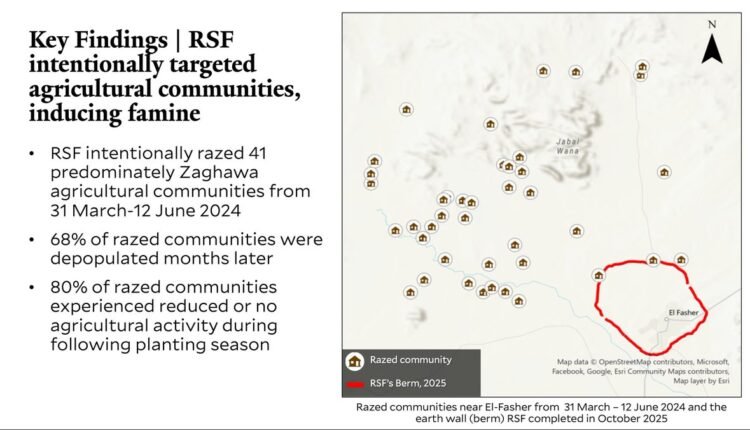
The study by the Yale Humanitarian Research Lab and NASA Harvest concluded that the Rapid Support Forces deliberately destroyed agricultural communities surrounding the Sudanese city of El Fasher in 2024 in an effort to starve local residents during an 18-month siege.
The report noted that these targeted attacks effectively depopulated 41 vital farming villages, severely disrupting the agricultural season and destroying local food supplies. These findings support a United Nations report issued in February which concluded that the RSF committed genocide in El Fasher, “including deliberately starving the city’s population.”
Rebecca Schuess, the study’s lead author and geospatial data analyst at Yale’s Humanitarian Research Lab, said: “The Rapid Support Forces deliberately targeted agricultural villages, causing intentional damage, killing farmers, and forcibly displacing them to prevent crop cultivation. This campaign of systematic attacks made an already scarce agricultural season in the region even more prolonged and catastrophic.”
Researchers at the lab believe that at least 28 of the 41 communities north and northwest of El Fasher were depopulated due to “deliberate arson attacks likely carried out by RSF forces between March 31 and June 12, 2024.”
According to the research, the RSF primarily targeted Zaghawa farming communities. Residents were either forcibly displaced or killed, resulting in a sharp decline in agricultural production in areas that traditionally served as key food sources for El Fasher. Targeting these communities destroyed the production of essential local food resources by displacing farmers and demolishing critical agricultural infrastructure.
Experts from Yale HRL and NASA Harvest analyzed a combination of publicly available information, environmental remote sensing data, and high-resolution satellite imagery to reach their findings. The lab also determined that “10 out of 41 communities were razed more than once, including one community razed at least seven times,” reinforcing the conclusion that the destruction was intentional.
The research conducted by the Yale Humanitarian Research Lab — part of the School of Public Health at Yale University — together with NASA Harvest is considered unprecedented. NASA commissioned the Harvest project in 2017 as a multidisciplinary consortium bringing together experts in agriculture and remote sensing who collaborate with farmers, agribusinesses, economists, humanitarian organizations, and governments to deliver critical agricultural assessments.
“This is the first report of its kind to use remote sensing data to confirm allegations of a deliberate starvation campaign,” said Dr. Danielle Paul, Faculty Director of Yale’s Humanitarian Research Lab and co-author of the report. “The study’s unique methodology, developed with support from NASA Harvest, represents a major step forward in using remote sensing to understand how food security is affected in communities experiencing armed conflict.”
Yale’s Humanitarian Research Lab remotely monitored communities surrounding El Fasher for months following RSF attacks. Researchers observed the absence of farming activity and dense vegetation growth covering civilian homes, buildings, and livestock enclosures, leading them to conclude that most of the communities had been abandoned.
The imagery, researchers noted, appears to confirm the RSF’s intent to forcibly displace residents and severely undermine their ability to cultivate, produce, and harvest food.
The report also indicated that, in addition to destroying local farmland, RSF forces prevented humanitarian organizations from delivering aid to the city.
According to the report, the RSF began its siege of El Fasher by attacking agricultural communities west of the city in April 2024 before encircling it, razing neighborhoods, shelling vital infrastructure, and blocking the entry of goods, including food and humanitarian assistance. In April 2025, RSF forces attacked and destroyed Zamzam IDP Camp, displacing an estimated half-million people. The group completed the construction of an earthen barrier surrounding the city in early October 2025 and seized control on October 26, 2025.
After the city’s fall, Yale human rights monitors documented evidence of mass killings, including the identification of more than 150 clusters of objects consistent with human remains.
During the 18-month siege and takeover of the city, Yale’s human rights office issued more than 65 reports documenting mass killings and other atrocities committed against the Fur, Zaghawa, and other non-Arab indigenous communities.
Shortlink: https://sudanhorizon.com/?p=12028