

Egypt Raises Its State of Alert… Al-Burhan in Cairo…A Reading Between the Lines
Cairo – Sudanhorizon – Sabah Musa
A heightened flurry of activity surrounds the Sudanese crisis these days. Visits, meetings, and continuous communications have not ceased since the Saudi Crown Prince’s trip to the United States. These may appear to be consultations or perhaps attempts to formulate approaches for resolving the crisis. What is reassuring, however, is that these movements remain confined to Washington, Riyadh, and Cairo.
Red Lines
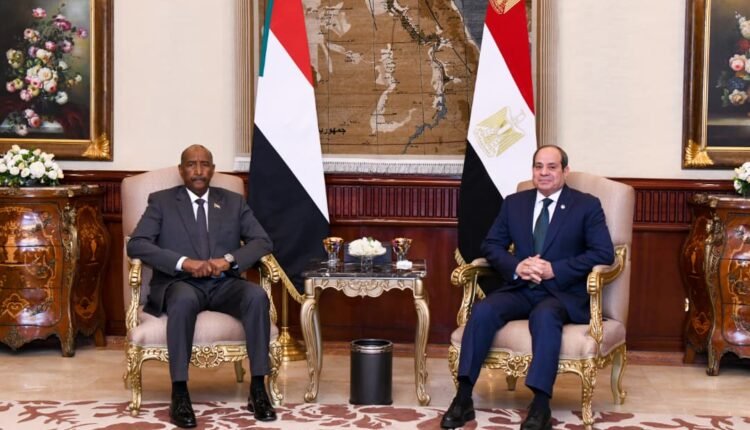
Three days after he visited Riyadh, the Chairman of the Sovereignty Council, General Abdel Fattah al-Burhan, arrived in Cairo today (Thursday). In a statement released after the meeting between President Abdel Fattah al-Sisi and al-Burhan, the Egyptian presidency stressed that Egypt will not allow any “red lines” in Sudan to be crossed, announcing that it had taken—without specifying them—measures to confront such threats.
The statement expressed Egypt’s deep concern over the ongoing escalation and intense tension in Sudan, and the horrific massacres and blatant violations of basic human rights inflicted on Sudanese civilians, particularly in al-Fashir. Egypt affirmed that there are red lines that cannot be crossed or tolerated, as they directly touch upon Egyptian national security, which is intrinsically linked to Sudan’s own national security.
The most important of these red lines, the statement said, are preserving Sudan’s unity and territorial integrity, including preventing the secession of any part of Sudanese territory, and safeguarding the institutions of the Sudanese state and preventing any harm to them.
Joint Defence
The statement further declared that Egypt retains the right to take all necessary measures permitted under international law and the Joint Defence Agreement between the two countries to ensure that these red lines are neither crossed nor threatened.
Egypt also reiterated its categorical rejection of the establishment or recognition of any parallel entities, considering them an affront to Sudan’s unity and territorial integrity. Cairo announced its full support for US President Donald Trump’s vision for achieving security, stability, and peace in Sudan, within the context of his broader efforts to promote peace and prevent escalation and conflict worldwide.
Egypt expressed its keenness to continue working within the framework of the international Quad (the US, UK, Saudi Arabia, and Egypt) to reach a humanitarian truce that would lead to a ceasefire and the creation of safe havens and humanitarian corridors to protect civilians—this, however, in full coordination with the institutions of the Sudanese state.
The Language of the Statement
Al-Burhan’s visits to Cairo are no longer surprising; they have become routine due to their frequency and the extensive coordination between the two countries on everything relating to the war, as well as external initiatives, agendas, and interventions.
What was surprising in this visit, however, was the tone of the Egyptian presidency’s statement, which was markedly different this time. It avoided any details on bilateral relations, water issues, or regional matters, focusing solely on the Sudanese crisis. It raised multiple red cards against any threat to Egyptian interests regarding Sudan—positions previously articulated in political or diplomatic language, but this time with far greater clarity and firmness, accompanied by an implicit threat to use force under the Joint Defence Agreement.
A Reference to the Quad
The statement also carried messages in all directions—to internal audiences, external actors, and supporters. It referred to the Quad despite the Sudanese government’s opposition to it, but linked Egypt’s commitment to the Quad and to a humanitarian truce leading to a ceasefire—with safe corridors and havens—to full coordination with Sudanese state institutions.
This implies that Sudanese state control over border crossings is essential to prevent the entry of logistical or military supplies to the militia. Egypt’s reference to its full support for Trump’s plan for peace and stability in Sudan may also signal the emergence of a new vision for resolving the crisis—perhaps an understanding among the Quad, Sudan’s position, and Egypt’s long-standing principles, which Saudi Arabia also continues to affirm. This reflects the Sudanese leadership’s involvement, headed by al-Burhan, in these consultations.
Escalated Rhetoric
Observers of Egyptian foreign policy will know that Cairo is not a state that is easily drawn into conflict, and rarely issues statements with emotional or escalatory language. Yet today’s statement clearly escalates Egypt’s tone regarding the Sudanese crisis, signalling that Egypt is aware of significant and dangerous developments behind the scenes. Hence, it’s decision to set red lines and raise warning cards—sending specific messages to all who have a stake in Sudan’s fate, whether allies or adversaries.
What, then, can we infer from al-Burhan’s visit to Cairo at this particular moment? And to what extent does this signal a new and evolving Egyptian position?
Strong and Decisive
Ambassador Salah Halima, Vice-President of the Egyptian Council for Foreign Affairs, believes that al-Burhan’s visit comes amid rapidly evolving developments on the battlefield, with grave militia violations and their acquisition of large quantities of advanced weaponry and mercenaries.
Halima told Sudanhorizon that there is military and logistical support for the Rapid Support Forces militia, as well as political backing for the “Ta’sis” group—factors that heighten the risk of secession through the creation of a parallel government. This, he said, necessitated Egypt’s raising of a red card against any parallel entities or any form of secession.
He added that Egypt is sending strong, decisive messages to all local, regional, and international parties and hinted that there are other red lines that cannot be crossed within the framework of international law and legitimacy, referring to the Joint Defence Agreement for the protection of national security.
He stressed that any attempt at secession would be met by a firm Egyptian response, noting that the red cards also apply to violations and the preservation of state institutions. He explained that Egypt’s moves may contribute to neutralising the militia’s regional backers, and may indeed influence their position.
Pure Diplomacy
For his part, journalist and political analyst Makki al-Maghribi said that there is consensus among Sudanese observers that this summit—and its resulting statement—differs completely from all that preceded it.
Speaking to Sudanhorizon, al-Maghribi noted that the statement clearly mentioned the red cards and called things by their names. He pointed out that the Joint Defence Agreement was mentioned for the first time in the context of the war, describing the agreement as still valid, having been passed by parliament and never revoked. Under constitutional doctrine, he said, it remains in force and only requires activation.
He noted that the strongest part of the statement was Egypt’s explicit rejection of Sudan’s partition, effectively nullifying the matter. He attributed Egypt’s escalated tone to the militia’s evasiveness and its insistence on exploiting the humanitarian crisis to impose a parallel constitutional reality.
As for the mention of the Quad, al-Maghribi described it as purely diplomatic, noting it was mentioned only out of respect for Egypt’s participation. However, its linkage to full coordination with the Sudanese government returns matters to square one.
Shortlink: https://sudanhorizon.com/?p=9687