

Dam Experts: U.S. Mediation to Resolve the GERD Crisis Faces Ethiopian Obstacles
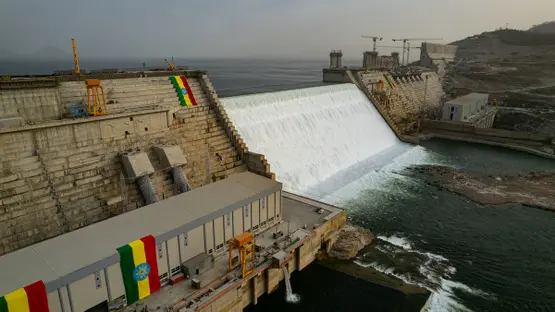
Sudanhorizon – Hala Hamza
Dam experts and former members of the government negotiating team on the Ethiopian Renaissance Dam have linked the success of the proposed U.S. mediation between Egypt and Ethiopia in resolving tensions surrounding the construction and operation of the dam to the implementation of certain technical conditions, while others have predicted its failure, similar to previous initiatives.
Member of the government negotiating team on the GERD, Engineer Diab Hassan, told Sudanhorizon that “the U.S. president’s initiative and mediation are in line with the technical requirements that must be implemented by the three countries.”
Hassan pointed to the possibility of coordination among Sudan, Egypt, and Ethiopia, with the United States, to operate the dam at the same storage level (74 billion cubic meters), while ensuring the water shares of Sudan and Egypt even during periods of drought, provided Ethiopia does not persist in what he described as its unjustified stance.
U.S. President Donald Trump had recently announced in messages to the presidents of Sudan, Egypt, and Ethiopia his readiness to resume American mediation between Egypt and Ethiopia to reach a decisive and fair solution to the issue of Nile water sharing and to resolve the ongoing tensions surrounding the GERD.
Diab called for allocating 50 billion cubic meters—within the average storage range—to be released through power generation or spillways, while retaining surplus water during periods of heavy flooding as a reserve.
He stressed that the U.S. president’s statement overlooked the issue of dam safety and how to protect Sudan and its facilities from the risks of natural disasters or a potential collapse.
He also pointed to the possibility that U.S. mediation could involve sending specialized technical teams, with the participation of Sudan and Egypt, to access the dam, inspect monitoring systems and the dam structure, ensure the safety mechanisms are functioning properly, and regulate water flow throughout the year so that Sudan and Egypt can operate their dams and plan for the future. He called for studying the environmental, social, and economic impacts along the river basin and developing and implementing effective solutions.
Trump proposed that his mediation, supported by technical backing and coordination, could lead to a permanent agreement ensuring regular and predictable water releases during drought periods for the benefit of Egypt and Sudan, while allowing Ethiopia to generate electricity, with the possibility of selling or providing part of it to Egypt or Sudan. He also called for preventing the dam dispute from escalating into a military conflict with Egypt.
For his part, Dr. Louay Abdel Moneim, an expert in international affairs, told Sudanhorizon that U.S. President Donald Trump’s renewed offer to mediate the GERD dispute comes at a time of heightened regional water and geopolitical tensions, through an official message sent to Egyptian President Abdel Fattah El-Sisi.
He added that this move, which comes after years of stagnation, raises fundamental questions about its chances of success, the limits of its influence, and the willingness of the three parties—Egypt, Sudan, and Ethiopia—to engage in a new negotiation track under U.S. sponsorship.
Dr. Abdel Moneim described Trump’s mediation as not new, noting that it began in late 2019 when the U.S. Treasury, in cooperation with the World Bank, invited the three parties to negotiations in Washington that continued until February 2020. Egypt initialed the agreement, while Ethiopia refused to attend or sign, arguing that Washington had exceeded its role as a mediator and shifted toward political pressure.
He explained that Egypt views U.S. mediation as an opportunity to revive its core demand: a legally binding agreement regulating the filling and operation of the dam and preventing unilateral actions that threaten its water security. Ethiopia, on the other hand, rejects any external intervention it perceives as infringing on its sovereignty and insists that the dam is a domestic development project beyond external interference.
Abdel Moneim noted that Sudan has adopted a middle-ground position, calling for technical and operational guarantees to ensure the safety of its dams and water security, but is constrained by internal challenges that limit its ability to exert effective influence.
He revealed that Washington possesses significant leverage that could be used to push the parties toward an agreement, including economic and military assistance—particularly to Egypt and Ethiopia—as well as influence within international financial institutions such as the World Bank and the International Monetary Fund, in addition to regional alliances, especially with Gulf states that maintain close relations with both Cairo and Addis Ababa.
However, he noted that these tools have not yet been clearly activated, raising questions about the seriousness of U.S. pressure and the extent of Washington’s commitment to achieving a real breakthrough.
He emphasized that the absence of a legally binding enforcement mechanism renders any agreement vulnerable to reversal or reinterpretation.
Abdel Moneim further explained that the current hydrological reality indicates that the dam is nearly complete and already operational, making any future agreement more about “damage management” than “damage prevention.”
He also pointed out that the absence of a unified African position and the declining role of the African Union weaken the prospects for collective solutions.
He concluded by saying: “Unless this mediation is backed by tangible measures and legal guarantees, it may turn into just another chapter in a series of diplomatic maneuvers. However, if leveraged wisely, it could open a narrow window toward a fair settlement that preserves rights and prevents a slide into open conflict.”
Shortlink: https://sudanhorizon.com/?p=10566