

Blue Nile Recedes: GERD or Sudan’s Water Management Behind the Crisis?
Cairo – Sudanhorizon – Sabah Mousa
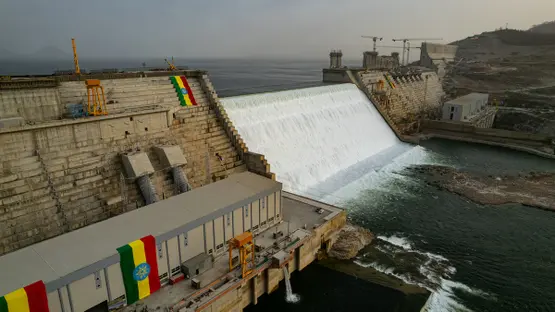
The unprecedented decline in the Blue Nile’s water levels over recent weeks has raised widespread concern in Sudan after drinking water supplies, irrigation, and electricity generation were disrupted in several areas. The drop has also led to complaints about the shutdown of a number of water stations and river pumps. While official authorities attributed the decline to Ethiopia’s annual filling of the Grand Ethiopian Renaissance Dam (GERD), debate has intensified over whether the dam is the direct cause of the crisis or whether shortcomings in Sudan’s water management have amplified its impact.
The issue has taken on particular significance as it brings one of Sudan’s most sensitive national concerns—water security—back into the spotlight. Millions of Sudanese depend on the Blue Nile for drinking water, irrigation, and hydropower generation, making it a critical pillar of the country’s food security and economic stability.
Reduced Releases
In a statement issued last Friday, Sudan’s Ministry of Irrigation and Water Resources confirmed a temporary reduction in Blue Nile inflows due to lower water releases from Ethiopia’s GERD. The ministry explained that fluctuations in river levels are a natural phenomenon but noted that the dam has fundamentally altered the river’s hydrology, creating a new reality for water resource management in Sudan.
A Fundamental Shift
Water experts argue that the full operation of the GERD has fundamentally transformed the Blue Nile’s hydrological system. Water flows are no longer governed solely by the natural flood cycle, as they were for decades, but are now also determined by the dam’s operational schedule. This, they say, requires Sudan to modernize the management of its reservoirs and adapt its operational policies to ensure stable water supplies.
Promised Benefits Never Materialized
International water expert and former adviser to Sudan’s Ministry of Irrigation, Dr. Ahmed El Mufti, said the promised benefits of the GERD for Sudan have not materialized. He argued that Sudan has not received the anticipated electricity from the project, nor have the promises of enabling three agricultural seasons per year been fulfilled. Farmers, he noted, continue to complain about water shortages and the loss of fertile riverbank lands (“jorouf”) without compensation.
Water Security
In a published statement, El Mufti criticized the omission of the principle of water security from the 2015 Declaration of Principles on the GERD, despite its inclusion in the Entebbe Agreement. He argued that Ethiopia proceeded unilaterally with constructing the dam and filling its reservoir without fully adhering to the declaration’s provisions requiring agreement on filling and operating rules.
He also noted that the International Panel of Experts that reviewed the project in 2013 raised concerns regarding the dam’s safety and the completion of technical studies, arguing that these issues have yet to be adequately addressed.
El Mufti further criticized several experts who defended the project, including former Irrigation Minister Dr. Othman Al-Tom and former legal adviser Dr. Salman Mohamed Ahmed. He pointed out that Ahmed had served as a legal adviser to the Ethiopian government, while Al-Tom had worked in Ethiopia before construction of the dam began, arguing that these facts should be considered when assessing their publicly stated positions.
The Crisis Cannot Be Reduced to the Dam Alone
On the other hand, writer Ibrahim Shaghlawi, in an article titled “The GERD… or Sudan’s Oversight?”, cited the views of Professor Seifeldin Hamad, former head of the Technical Committee at Sudan’s Ministry of Water Resources. Hamad argued that the crisis cannot be attributed solely to the GERD but is also linked to how Sudan manages its own water resources under the new conditions created by the dam.
According to the article, Hamad explained that the GERD’s annual filling follows a well-known schedule during the flood season and that Sudan was fully aware of those dates. He said that water releases from the dam during the first half of the year were sufficient for Sudan to store adequate reserves in the Roseires Dam before the annual filling period began.
In his view, the central issue is not merely the volume of available water but how Sudan manages it. He noted that Sudan and Ethiopia signed technical arrangements in October 2022 to exchange information and coordinate dam operations. The problem, he argued, lies not in the lack of data but in the failure to translate that information into proactive operational decisions, while Sudan’s dams continue to be managed according to policies established before the GERD became operational.
Hamad called for an independent Sudanese approach to dealing with the GERD, based on Sudan’s own water security priorities rather than regional political polarization. He also criticized the Ministry of Irrigation’s statement for linking the drop in water levels solely to Ethiopia’s reservoir filling without explaining what measures Sudan had taken to prepare for this stage.
Governance and Water Management
This perspective highlights another dimension of the crisis: governance and institutional management of the water sector. Experts argue that possessing technical information alone is insufficient unless supported by effective decision-making institutions and flexible operational strategies capable of adapting to the new hydrological realities created by the GERD.
The crisis has also revived debate over the absence of a legally binding agreement between Sudan, Egypt, and Ethiopia governing the dam’s filling and operation. Observers argue that technical arrangements for data exchange, while important, cannot replace a legal framework defining the rights and obligations of all parties and establishing procedures for managing droughts and emergency situations.
Ignoring the Root Causes
Responding to Hamad’s arguments, El Mufti said that calls to adapt to the new reality address only part of the problem while ignoring its root causes. He held the Sudanese negotiating team, headed by Professor Seifeldin Hamad, responsible for failing to secure a legally binding agreement that would provide for joint management of the dam and safeguard Sudan’s water security.
Speaking to Sudanhorizon, El Mufti stressed that the October 2022 technical arrangements cannot substitute for a comprehensive legal agreement governing the dam’s filling and operation. He warned that the risks associated with the GERD extend beyond the current decline in water levels and include future concerns over the dam’s structural safety, including the possibility of partial or total collapse, as well as potential impacts on Sudan’s future water share as development and agricultural demands increase.
He added that one of the major shortcomings of the 2015 Declaration of Principles was its failure to explicitly incorporate the concept of water security, despite Ethiopia’s acceptance of the principle under the Entebbe Agreement. El Mufti also noted that Hamad recently published a book titled Water Security, describing this as contradictory to the positions taken during the negotiations.
Technical Coordination
Despite the differing views of El Mufti and Hamad, the crisis underscores the interaction of several factors, including Ethiopia’s annual filling of the GERD, the operational management of Sudan’s dams, and the level of technical coordination among the relevant institutions. As a result, experts continue to debate whether responsibility can be attributed to any single factor.
Reopening the Debate
As the debate continues, the decline of the Blue Nile has become more than a seasonal fluctuation in water levels. It has reopened a broader national discussion about the future of water resource management in Sudan, the readiness of its institutions to adapt to the new hydrological reality created by the GERD, and whether the country needs to overhaul its water policies and institutional framework while continuing efforts to secure a legally binding agreement that balances development needs with the protection of Sudan’s water security.
Shortlink: https://sudanhorizon.com/?p=16199